I’ve written before about why breaking modern encryption is a multi-billion-year problem attackers simply don’t bother attempting. That single fact explains almost everything else in security, including why the term human firewall exists at all. When the math is unbreakable, attackers go around it — straight at the person holding the keys. A human firewall is what stands in their way when they do.
This guide covers what a human firewall actually is, why it matters more than most technology budgets suggest, how to build one deliberately rather than hope it emerges from a training slide deck, and how to tell if yours is actually working.
What Is a Human Firewall?
A human firewall is a workforce trained and motivated to recognize, resist, and report security threats — functioning as a line of defense that operates on judgment rather than code, catching what technical controls miss or never see in the first place.
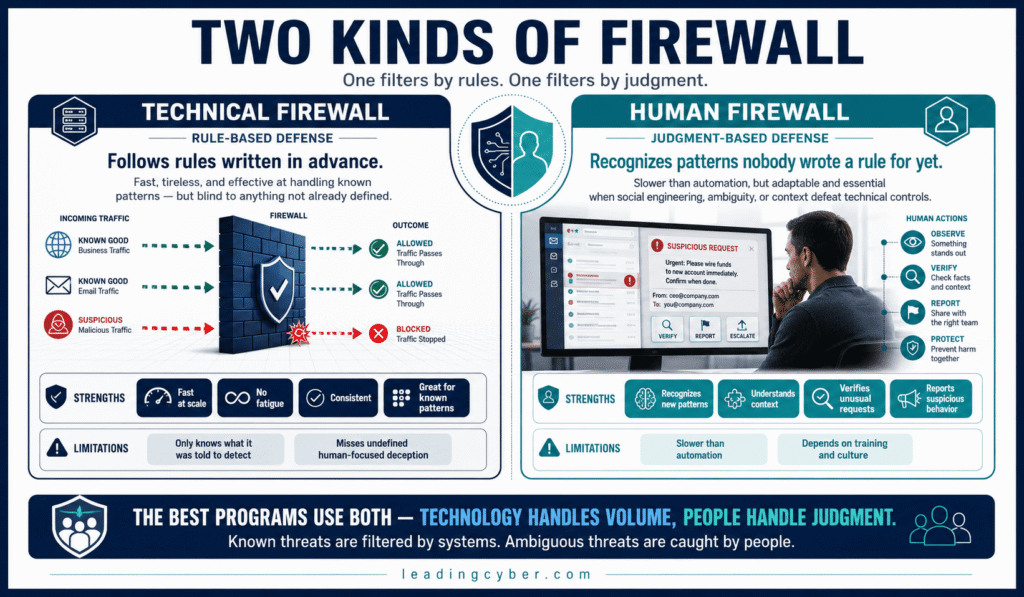
The metaphor is doing real work here. A firewall inspects traffic and decides what passes; a trained employee inspects an email, a phone call, a request, and decides the same thing. The difference is that a technical firewall follows rules written in advance, while a human firewall has to recognize threats nobody wrote a rule for yet — which is exactly why it matters against the attacks that matter most.
Why Technology Alone Can’t Be the Last Line of Defense
Here’s the uncomfortable math behind this entire topic. Modern cryptography is, for practical purposes, unbreakable at proper key lengths. Attackers know this better than anyone, which is exactly why phishing remains the dominant attack vector year after year despite decades of technology investment. Nobody breaks in through the vault door when they can call the person who knows the combination.
Every technical control — spam filters, endpoint protection, network segmentation — reduces how often a threat reaches a human. None of them reduce that number to zero, and the ones that get through are, by definition, the ones sophisticated enough to slip past automated detection. Those are exactly the attacks that need a human to catch them. That’s not a knock on the technology; it’s the honest division of labor between the two.
What Makes an Employee a Human Firewall
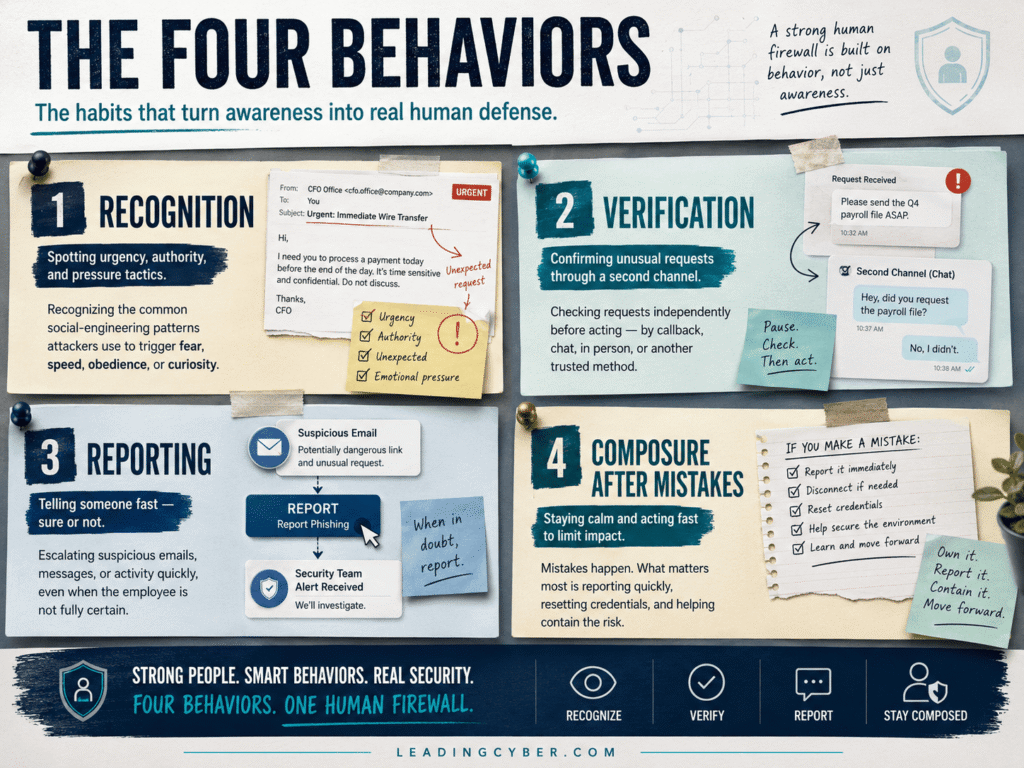
Four behaviors, in practice, separate a trained workforce from an untrained one:
- Recognition. Spotting the patterns behind urgency, authority, and pressure — the same tells that show up in real phishing email examples again and again, because attackers keep reusing what works.
- Verification. Confirming unusual requests through a second channel before acting — a callback, a Slack message, anything that isn’t the same medium the request arrived through. This single habit defeats the overwhelming majority of impersonation attempts.
- Reporting. Actually telling someone, fast, whether or not they’re sure. I’ve covered how to report phishing in Outlook in detail elsewhere, but the mechanics matter less than the instinct — an employee who reports a false alarm is doing exactly what you want.
- Composure after a mistake. Knowing what to do after clicking something they shouldn’t have, and doing it immediately instead of hiding it. This is the behavior most programs fail to build, because it requires trust the organization has to earn first.
Notice that three of these four are about what happens after a mistake or a near-miss, not before it. That’s deliberate — a human firewall isn’t a workforce that never makes mistakes. It’s a workforce whose mistakes get caught fast because nobody’s afraid to speak up.
How to Build a Human Firewall
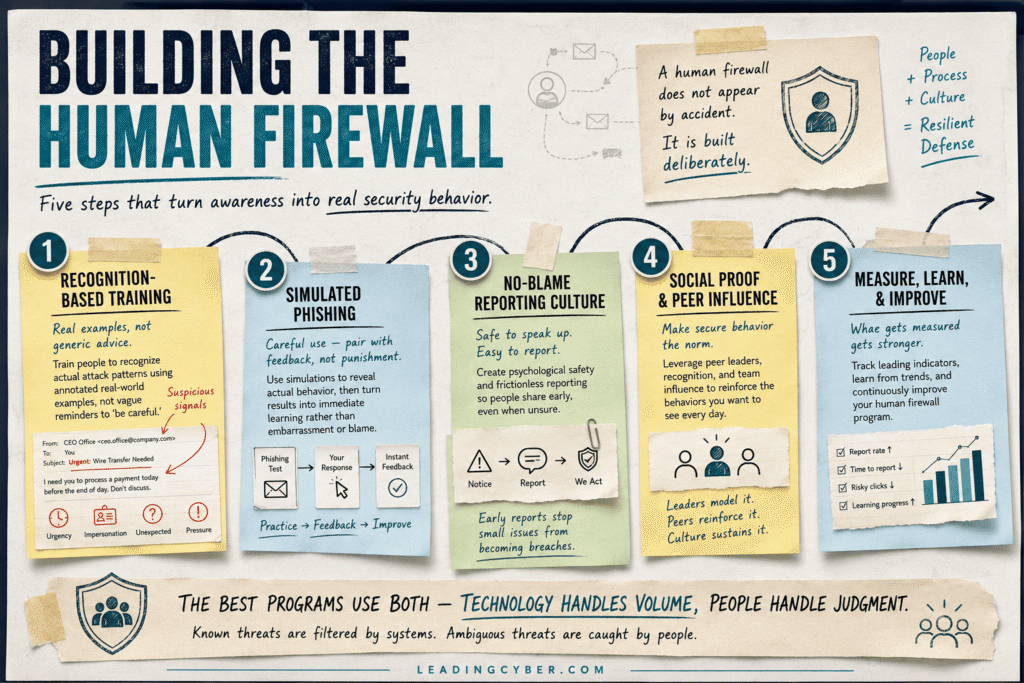
1. Make Training Recognition-Based, Not Rule-Based
Generic “don’t click suspicious links” advice doesn’t build recognition; annotated real examples do. Walk through actual attempts your organization has received, point at the specific tell, and repeat that regularly rather than once a year. This mirrors exactly what I’ve found works for any kind of skills training that has to survive contact with a busy Tuesday — spaced, practiced, and grounded in real scenarios beats a single annual seminar every time.
2. Run Simulated Phishing — Carefully
Simulated phishing tests reveal your actual click rate, not your assumed one, and that gap is usually larger than leadership expects. The careful part matters: simulations aimed at catching people out breed resentment and silence, while simulations paired with immediate, blame-free feedback build exactly the recognition muscle you’re after. The difference is entirely in how results get used afterward.
3. Build a No-Blame Reporting Culture — And Mean It
This is the one that actually determines whether the other two work. If someone who reports a mistake gets publicly named or quietly punished, reporting stops within a single incident cycle — word travels fast. Thank people who report, including false alarms, visibly and often. Say explicitly, from leadership, that fast reporting is never punished. Then prove it the first time it’s tested.
4. Create Visible Champions
Identify a handful of people in each department who are naturally good at this and give them a name and small recognition — security champions, or whatever fits your culture. Peer influence changes behavior faster than policy documents ever will, and a champion two desks away is more persuasive than any mandatory training module.
5. Close the Loop With Metrics
Track it or it doesn’t improve. The next section covers exactly what to measure.
Common Mistakes That Weaken a Human Firewall
- Punishing simulation failures. The fastest way to guarantee people hide real mistakes is to publicly shame simulated ones.
- Annual-only training. A once-a-year seminar produces a once-a-year memory. Attackers don’t work on that schedule, and neither should awareness.
- Measuring the wrong thing. Tracking training completion instead of behavior change confuses attendance with learning — a distinction that matters everywhere, not just here.
- Leaving leadership exempt. If executives skip the training or ignore the reporting process, the message that lands is that none of it actually matters. Nowhere is this more dangerous than with whaling, which specifically targets the people most likely to consider themselves above the process.
Measuring Human Firewall Strength
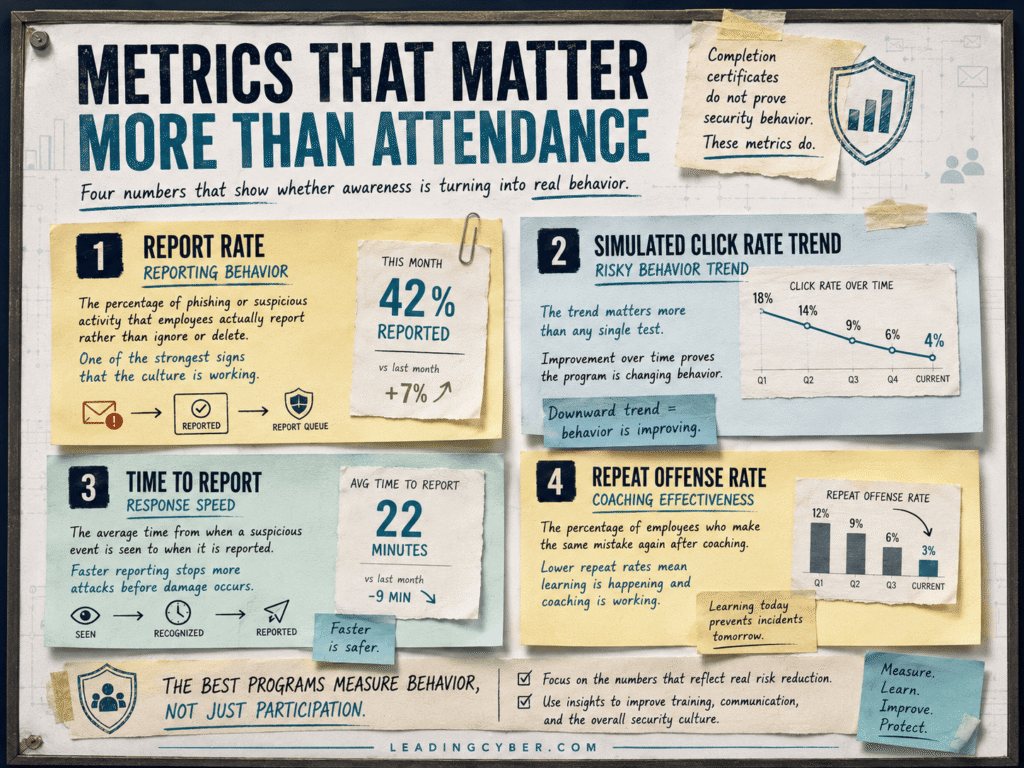
Four numbers tell you more than any survey:
- Report rate — what percentage of received phishing (real or simulated) gets reported, rather than ignored or deleted. This is the single best proxy for whether your culture is actually working.
- Simulated click rate over time — trending down matters more than any single snapshot. A single test result is a data point; the trend is the program.
- Time to report — minutes matter enormously here, especially against fast-moving threats like ransomware, where a delayed report is the difference between a contained incident and a headline.
- Repeat-clicker trend — not to punish individuals, but to identify where targeted coaching (not shame) would help most.
All four together tell a story raw training-completion numbers never will — which circles back to the same lesson from people, process, and technology: the technology can flag a threat, but only the people and the process around them decide what happens next.
Key Takeaways
- A human firewall is a workforce trained to recognize, verify, report, and stay composed after mistakes — judgment where code runs out
- It exists because unbreakable cryptography pushes attackers toward the one layer that isn’t mathematically hardened: people
- Building one takes recognition-based training, careful simulated phishing, and — above all — a genuinely no-blame reporting culture
- Leadership has to be inside the process, not exempt from it, especially given how whaling specifically targets executives
- Measure report rate, click-rate trend, time to report, and repeat-clicker patterns — not just training completion
Frequently Asked Questions
What is a human firewall?
A human firewall is a workforce trained and motivated to recognize, resist, and report security threats, functioning as a line of defense based on judgment rather than code. It catches the attacks that slip past technical controls — usually the most sophisticated ones, since anything simple enough for automated tools to catch never reaches a person in the first place.
Why is a human firewall important?
Because modern encryption is effectively unbreakable at proper key lengths, attackers overwhelmingly target people instead of technology. Every technical control reduces how often a threat reaches an employee, but none reduce it to zero — and the threats that do get through tend to be the ones sophisticated enough to have already evaded automated detection, which makes trained human judgment the layer that catches what nothing else did.
How do you build a human firewall?
Use recognition-based training built on real, annotated examples rather than generic advice; run simulated phishing paired with blame-free feedback rather than punishment; build and repeatedly demonstrate a genuine no-blame reporting culture; identify and support natural security champions within teams; and track behavioral metrics rather than just training completion. The no-blame culture is the step that determines whether all the others actually work.
What is the difference between a human firewall and security awareness training?
Security awareness training is one input; a human firewall is the outcome. Training that isn’t paired with a no-blame reporting culture, regular practice, and behavioral measurement often produces awareness without producing action — people who technically know what phishing looks like but still hesitate to report it. A true human firewall is measured by behavior change, not training completion certificates.
How do you measure human firewall effectiveness?
Track the report rate for phishing (real and simulated), the trend in simulated phishing click rates over time, how quickly employees report suspicious activity, and patterns among repeat clickers to identify where targeted coaching helps most. Together these behavioral metrics reveal far more than training completion rates, which measure attendance rather than actual change in behavior.
Why do employees fail to report phishing even after training?
Most often because they fear blame, embarrassment, or being seen as careless — especially if a previous report or mistake was met with criticism rather than thanks. Training can teach recognition, but only a demonstrated, consistently enforced no-blame culture removes the fear that keeps people silent. Organizations that publicly thank people for reporting, including false alarms, see reporting rates rise significantly faster than those relying on training alone.