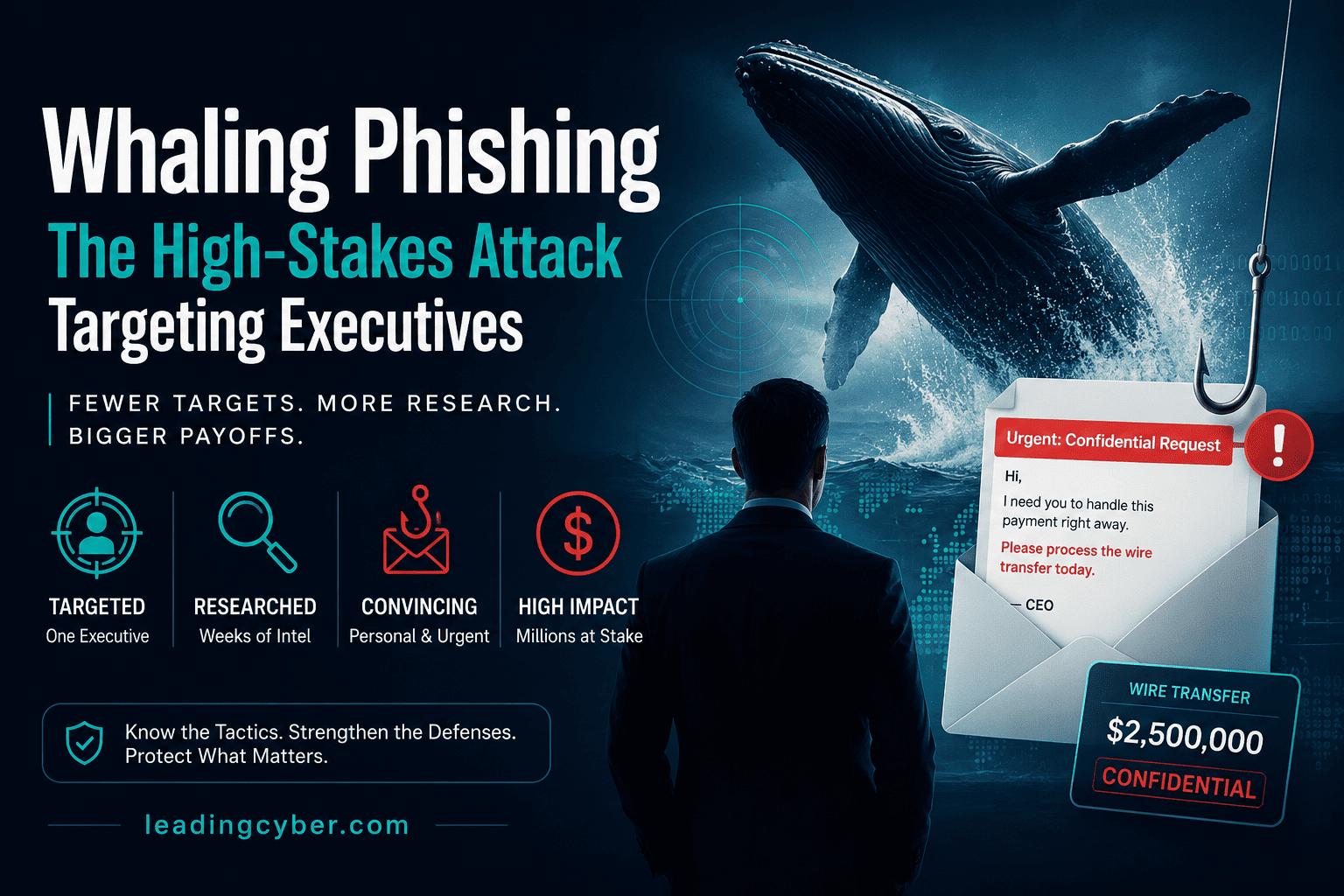
Most phishing casts a wide net. Whaling phishing brings a harpoon. Instead of blasting thousands of inboxes with generic bait, whaling targets one specific, high-value person — a CEO, CFO, or senior executive — with a message researched and written just for them. The stakes match the targeting: a single successful whaling attack can move millions of dollars with one convincing email.
In this guide, I’ll explain what whaling phishing is, how it differs from spear phishing, how a whaling attack unfolds stage by stage, why executives — despite their experience — fall for it, and the defenses that actually work.
What Is Whaling Phishing?
Whaling phishing (also called a whaling attack or CEO fraud) is a highly targeted phishing attack aimed at senior executives and other high-profile individuals, using personalized research and impersonation to steal money, credentials, or sensitive data. The name comes from the fishing metaphor: ordinary phishing catches whatever bites, while whaling hunts the biggest fish in the organization — the “whales.”
Whaling messages rarely look like spam. They reference real projects, real colleagues, and real deadlines. Furthermore, they either impersonate an executive (to pressure employees below them) or target the executive directly (to capture the credentials and authority only they hold).

Whaling vs. Phishing vs. Spear Phishing
The three terms describe the same crime at increasing levels of focus:
- Phishing — mass-volume, generic messages sent to thousands of people. “Your package couldn’t be delivered.” Cheap to run; success rate per email is tiny, but the volume compensates.
- Spear phishing — targeted at a specific person or small group, personalized using details like your name, employer, or role. More research, far higher success rate than standard phishing.
- Whaling — spear phishing’s apex: the target is specifically a senior executive or someone with financial authority. Weeks of research, near-perfect impersonation, and payoffs measured in wire transfers rather than stolen passwords.
In other words, every whaling attack is spear phishing, but not every spear phishing attack is whaling — the difference is who’s on the hook and how much power they hold.
How a Whaling Attack Works, Stage by Stage
Whaling succeeds because of the preparation you never see. A typical attack unfolds in four stages:
- Research. Attackers mine LinkedIn, press releases, conference bios, earnings calls, and social media. They learn who reports to whom, which deals are in progress, when the CEO travels, and how executives write — tone, sign-offs, even typos.
- Setup. They register a lookalike domain (one letter off from the real one), spoof an email address, or in the worst case compromise a real executive mailbox. Some build fake supplier identities to match an ongoing project.
- The strike. A carefully timed message lands — often while the impersonated executive is traveling or in a board meeting and hard to reach. It requests a wire transfer, a payment-detail change, sensitive HR or tax data, or credentials for a “board document.” Urgency and confidentiality are almost always built in: “Handle this quietly before end of day — I’m boarding a flight.”
- The cash-out. Funds move through mule accounts and disappear within hours. Data gets sold or used for the next, deeper attack. Therefore, response speed — noticing and reporting within minutes, not days — is the difference between a recovered wire and a write-off.

Real-World Whaling: What the Big Cases Teach
Whaling isn’t theoretical. In one of the most widely reported cases, Austrian aerospace supplier FACC lost roughly €50 million in 2016 to an email impersonating its CEO in a fake acquisition — and the incident ultimately cost both the CEO and CFO their jobs. Around the same era, tech company Ubiquiti disclosed losing $46.7 million to impersonation fraud targeting its finance department.
Moreover, the pattern in nearly every public case is identical: no malware, no hacking in the Hollywood sense — just a convincing identity, a plausible business reason, urgency, and a request that bypassed normal process. The technology worked fine. The verification process didn’t exist.
Why Executives Fall for It
It’s tempting to assume seniority equals immunity. The opposite is often true, and the reasons are human, not technical:
- Their information is public. Executives have bios, interviews, travel schedules, and org charts published everywhere — free reconnaissance for attackers.
- Speed is their culture. Senior leaders process hundreds of messages fast and are rewarded for decisiveness. Attackers weaponize that pace.
- Authority suppresses questions. When “the CEO” asks for something urgent and confidential, few employees push back — and executives themselves are used to acting without asking permission.
- They’re often exempt from controls. Ironically, executives frequently skip the security training and get exceptions from the email policies everyone else follows.

How to Prevent Whaling Attacks
Whaling defense is mostly process and culture, with technology in a supporting role:
- Out-of-band verification for money. Every wire transfer, payment-detail change, or unusual financial request gets verified by voice on a known number — no exceptions, no matter who’s asking or how urgent it sounds. This single control defeats most whaling.
- No-exception rule for executives. The verification process applies especially to requests appearing to come from the top. If the CEO’s real request can’t survive a confirmation call, the process is working as designed.
- Email authentication. Deploy SPF, DKIM, and DMARC to make direct domain spoofing hard, and flag external emails visibly so lookalike domains stand out.
- Executive-specific training. Leaders need their own briefing — including what attackers can learn about them publicly, and a review of real phishing email examples like the CEO gift-card play their employees will face in their name.
- Shrink the public attack surface. Audit what the organization publishes about executive schedules, direct contact details, and internal structure.
- Fast, blame-free reporting. Ensure everyone knows how to report phishing in Outlook, and that anyone who clicked knows what to do after clicking a phishing link — because with wire fraud, minutes decide whether money comes back.
For IT Leaders: The Control That Protects the Top
Here’s the leadership conversation whaling forces: the strongest predictor of whaling resilience isn’t your email filter — it’s whether an intimidated junior accountant feels authorized to say no to the CEO. That authorization has to be granted from the top, publicly and repeatedly: “If you get an urgent payment request from me, verify it. I will never punish the delay.”
Furthermore, this is the purest example of security as a people, process, and technology problem: the technology flags the lookalike domain, the process demands the callback, but only culture makes the callback actually happen under pressure.
Key Takeaways
- Whaling phishing targets executives specifically, using deep research and impersonation for high-value theft
- Every whaling attack is spear phishing — the difference is the seniority and authority of the target
- Attacks follow four stages: research, setup, strike, cash-out — most of the work is invisible preparation
- Executives are vulnerable precisely because of their public profiles, pace, and exemptions from controls
- The killer defense is procedural: voice-verify every financial request, with zero exceptions for the top

Frequently Asked Questions
What is whaling phishing?
Whaling phishing is a highly targeted phishing attack aimed at senior executives or other high-profile individuals, using personalized research and impersonation to steal money, credentials, or sensitive data. The name extends the fishing metaphor: while regular phishing catches anything that bites, whaling hunts the organization’s biggest fish.
What is the difference between whaling and spear phishing?
Spear phishing targets a specific person or group with personalized bait; whaling is spear phishing aimed specifically at senior executives or people with high financial authority. Every whaling attack is spear phishing, but whaling involves deeper research, more convincing impersonation, and much larger payoffs — typically wire transfers rather than stolen passwords.
Why is it called whaling?
The term comes from the fishing metaphor behind “phishing.” Mass phishing is like casting a wide net for any catch, spear phishing takes aim at a chosen fish, and whaling hunts the biggest fish in the water — the “whales,” meaning CEOs, CFOs, and other executives whose authority makes them uniquely valuable targets.
What is an example of a whaling attack?
A classic pattern: an email appearing to come from the CEO reaches someone in finance, referencing a confidential acquisition and requesting an urgent wire transfer before end of day. In one widely reported real case, aerospace supplier FACC lost roughly €50 million to exactly this scheme in 2016 — no malware involved, just impersonation, urgency, and a bypassed verification process.
How do you prevent whaling attacks?
The strongest defense is procedural: require out-of-band voice verification for every wire transfer or payment change, with no exceptions for executive requests. Support it with SPF, DKIM, and DMARC email authentication, external-sender flags, executive-specific security training, a reduced public footprint for leadership, and a blame-free culture where fast reporting is expected and praised.
Is whaling the same as CEO fraud or business email compromise?
They overlap heavily. Business email compromise (BEC) is the broad category of attacks using impersonated or compromised business email for fraud. CEO fraud is BEC that impersonates an executive to pressure employees. Whaling emphasizes the targeting of executives themselves — but in practice, the terms describe the same family of attacks and share the same defenses.