Walk into almost any IT department and you’ll hear the same refrain: “We need better security tools.” However, after decades working in public-sector IT, utilities, and large municipal organizations, I’ve reached a different conclusion. Most breaches don’t happen because a firewall failed — they happen because the people, process, technology triad fell out of alignment. Technology is simply where the symptoms show up.
In this article, I’ll explain what the people process technology framework means in a security context, walk through the most common causes of data breaches, share a real-world example from a municipal infrastructure project, and show you the leadership shift that actually improves an organization’s security posture. Therefore, if your instinct after every incident is to buy another tool, this one is for you.

What Is the People, Process, Technology Framework?
The people, process, technology (PPT) framework is a management model stating that organizational performance depends on three elements working together: the people who do the work, the processes that define how work gets done, and the technology that supports both. Furthermore, if any one of the three is weak or misaligned, the other two cannot compensate.
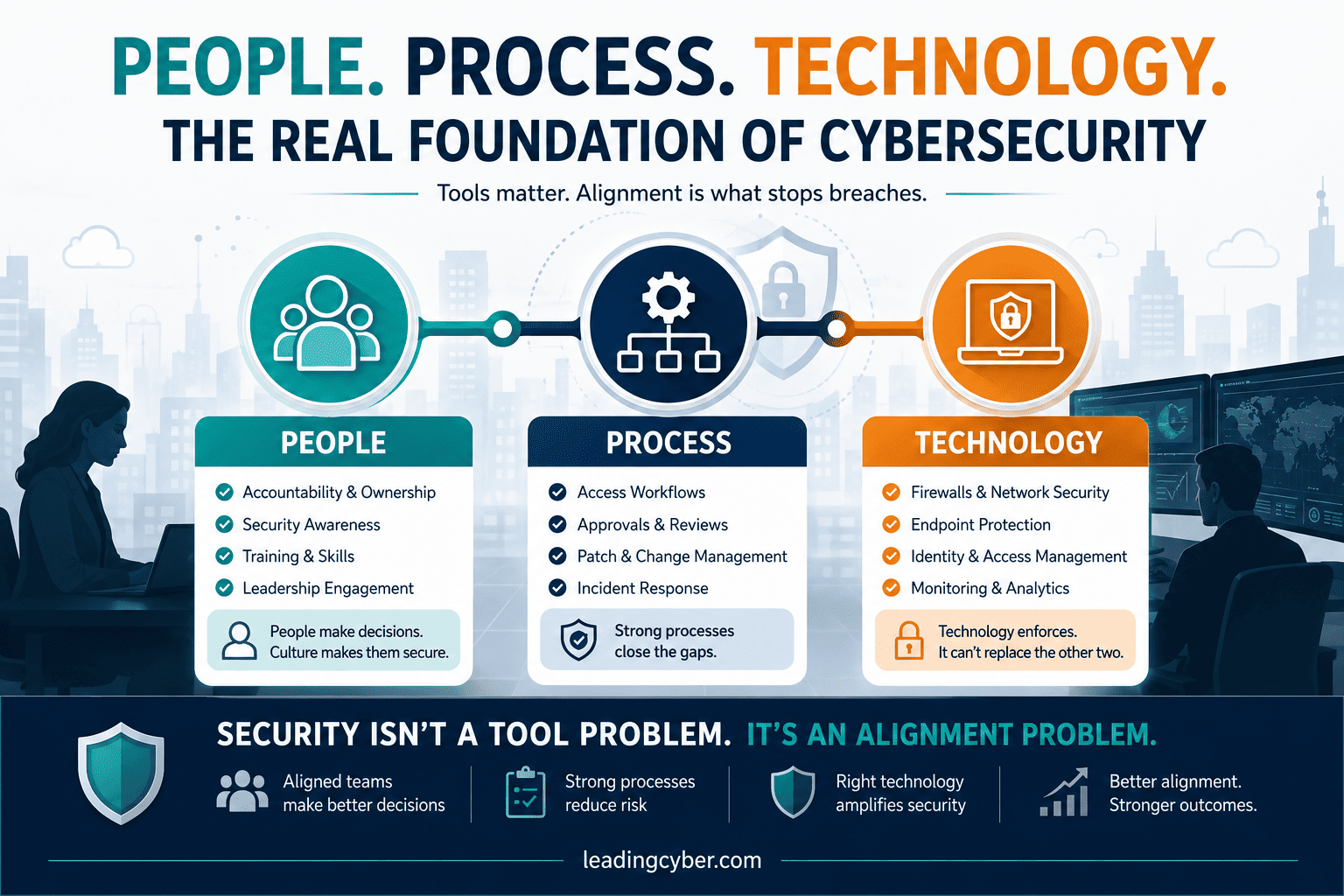
In cybersecurity, this means a security program is only as strong as its weakest pillar:
- People — accountability, skills, security awareness, and leadership engagement
- Process — access workflows, patching cadence, approvals, reviews, and incident response
- Technology — firewalls, endpoint protection, monitoring, and identity platforms
Most organizations invest heavily in the third pillar and starve the first two. Moreover, that imbalance — not a lack of tools — is where security failures are born.
The Technology Pillar Is Already Strong
Modern organizations are not lacking security products. In fact, many have too many.
I’ve walked into environments with multiple monitoring platforms, several layers of endpoint protection, and more dashboards than any team could realistically watch. On paper, the technology looked solid. However, something small still slips through:
- A phishing email that lands in exactly the wrong inbox
- A misconfigured access role nobody reviewed
- An unpatched server that everyone assumed someone else owned
That’s not a technology failure. That’s a coordination failure. Cybersecurity doesn’t break because tools don’t exist. Instead, it breaks because the human systems around them — ownership, accountability, communication — aren’t aligned.
The Most Common Causes of Data Breaches Are Human
The data backs this up. Verizon’s Data Breach Investigations Report has consistently found that the majority of breaches involve a human element rather than a pure technical exploit. In other words, the most common causes of data breaches are not exotic zero-day attacks. They are ordinary human factors in cybersecurity:
- Human error — misconfigurations, misdirected emails, and mistakes made under pressure
- Stolen or weak credentials — often harvested through phishing and social engineering
- Privilege misuse — legitimate access used carelessly or maliciously
- Process gaps — unpatched systems, unreviewed permissions, and unclear ownership
Therefore, every one of those causes lives in the people and process pillars — the two pillars most security budgets ignore.

When Process Fails: A Real-World Example
Let me give you a simple example from the field.
Years ago, during a large municipal infrastructure project, we had excellent perimeter security and network monitoring. The tools were doing exactly what they were designed to do.
The vulnerability? A workflow.
A contractor needed temporary access to a system. However, the request process was informal — basically an email chain. No clear expiration date. No consistent approval path. Over time, accounts accumulated. Access permissions drifted. Nobody noticed.

The technology worked fine. The governance didn’t.
This pattern shows up everywhere, in organizations of every size. Furthermore, when you trace a security failure back to its origin, you usually find one of three things:
- Unclear ownership — nobody was explicitly responsible for the system or the data
- Rushed or informal processes — access, changes, or exceptions handled ad hoc
- Silent assumptions — “I thought your team was patching that”
None of those problems can be solved by buying another tool.
Aligning People, Process, Technology in Cybersecurity
The organizations that handle security well tend to do one thing consistently: they keep people, process, and technology in alignment. In practice, alignment looks like this:
- People: clear accountability for every system and dataset — a named owner, not a shared inbox — plus leadership that treats cybersecurity as a business issue, not just an IT task
- Process: well-defined operational workflows — access requests, approvals, and reviews with expiration dates and audit trails
- Technology: a right-sized security stack that supports those processes instead of substituting for them
In my experience leading large-scale technology programs — some supporting utilities, others supporting municipal operations — the strongest cybersecurity posture never came from buying the newest tool. Instead, it came from clarity.
Who owns the system? Who approves access? Who reviews the logs? Who is responsible when something breaks?
When those answers are obvious to everyone, security improves dramatically — often without spending another dollar on software.
Building a Security Culture: Your Human Firewall
This is also where cybersecurity culture comes in. A strong security culture turns your workforce into a human firewall — employees who recognize phishing attempts, question unusual requests, and report incidents early because they understand why it matters. Moreover, culture is what keeps processes alive after the training session ends. Technology enforces rules; culture makes people want to follow them.
The Leadership Shift: From IT Project to Operational Discipline
Here’s the real shift leaders eventually make.
Cybersecurity stops being a “technology project” and becomes an operational discipline. It sits alongside finance, safety, and cybersecurity risk management. Furthermore, it becomes part of how the organization runs — not something the IT department manages quietly in the background.

And once that happens, something interesting occurs: the technology suddenly starts working a lot better.
Not because the tools changed.
Because the organization did.
Key Takeaways
- The people, process, technology framework explains most security outcomes — tools are only one pillar of three
- The most common causes of data breaches are human error, credential theft, and process gaps — not failed technology
- Access creep and unclear ownership are silent vulnerabilities that no tool can fix
- A strong cybersecurity culture turns employees into a human firewall
- Security matures when leadership treats it as an operational discipline alongside finance and risk management
Frequently Asked Questions
What is the people, process, technology framework?
The people, process, technology (PPT) framework is a management model stating that organizational performance depends on three balanced elements: skilled and accountable people, well-defined processes, and supporting technology. Furthermore, if any pillar is weak, the other two cannot compensate for it — which is why tool-heavy security programs still get breached.
Why is people, process, technology important in cybersecurity?
Because most breaches stem from human error, informal workflows, or unclear ownership rather than failed tools. Therefore, applying the people, process, technology framework ensures security investments cover accountability and governance — not just software — closing the gaps attackers actually exploit.
Which is most important: people, process, or technology?
People. Technology and processes are both designed, operated, and bypassed by people. Moreover, organizations with clear ownership, engaged leadership, and a strong security culture consistently outperform those that rely on tools alone, even with smaller security budgets.
What is an example of a process failure in cybersecurity?
A common example is access creep: a contractor is granted temporary access through an informal email request with no expiration date or approval path. The account is never revoked, permissions accumulate unnoticed, and the forgotten account eventually becomes an entry point for attackers.
How do you align people, process, and technology?
Assign a named owner to every system and dataset, formalize access and change workflows with expiration dates and audit trails, review permissions and logs on a schedule, and elevate cybersecurity to a leadership-level operational discipline alongside finance and risk management. Furthermore, invest in security culture so processes survive beyond the training session.