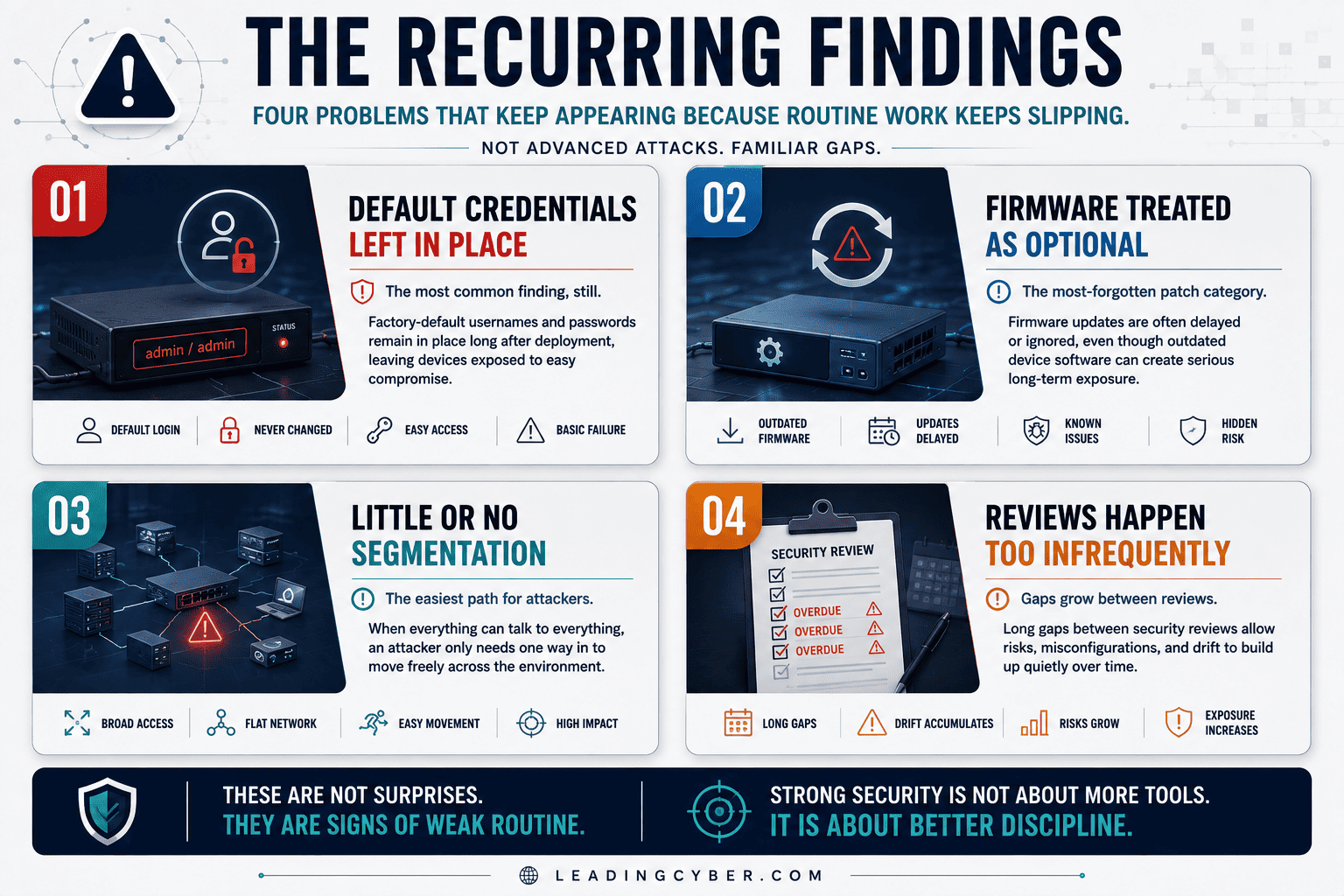
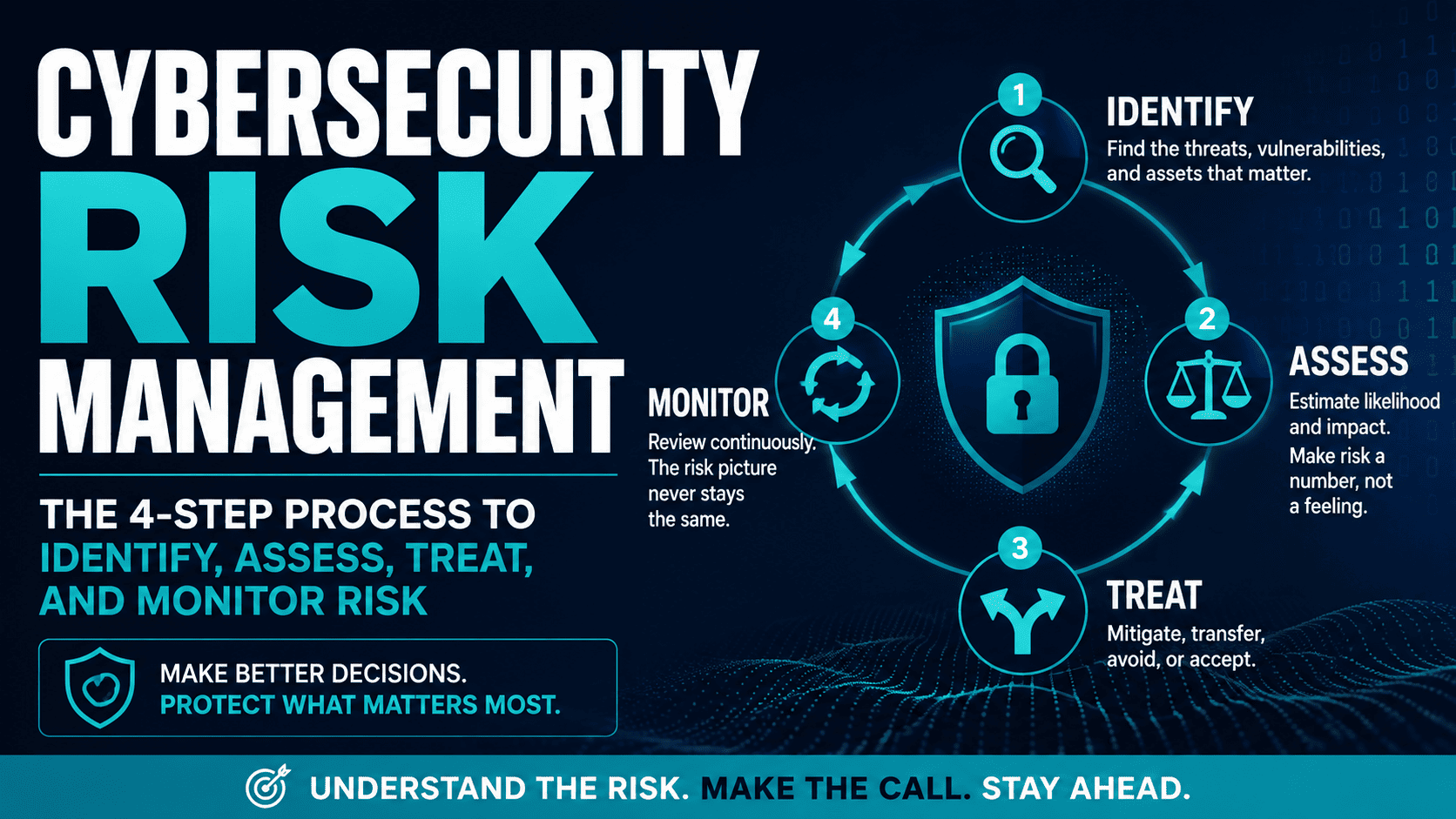
Every security decision I’ve watched go wrong shared one root cause: someone tried to eliminate risk instead of managing it. You can’t eliminate risk in any meaningful system — you can only understand it well enough to decide, deliberately, what to do about each piece of it. That’s the entire discipline of cybersecurity risk management in one sentence, and it’s the difference between a security program that protects the business and one that just spends money nervously.
This guide covers what cybersecurity risk management actually is, the four-step process behind it, the formula that makes “risk” a number instead of a feeling, the four ways to treat any given risk, and how to build a risk register that leadership will actually read.
What Is Cybersecurity Risk Management?
Cybersecurity risk management is the ongoing process of identifying, assessing, and responding to risks to an organization’s information and systems, so that security investment gets directed at what would actually hurt the business most — rather than spread evenly across everything or driven by whichever threat made headlines this week.
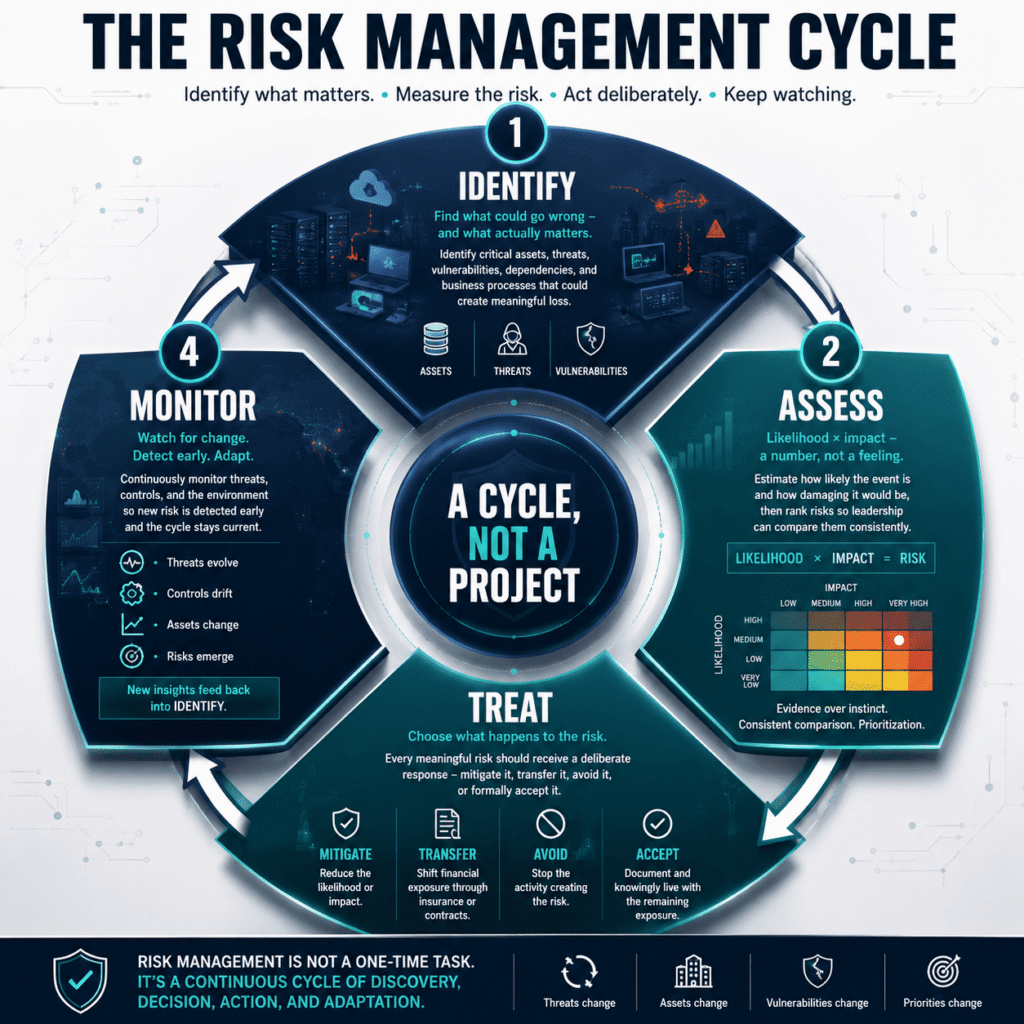
The word “management” is doing real work in that phrase. This isn’t a one-time assessment that produces a PDF nobody opens again. It’s a cycle, because risk isn’t static — new systems, new vendors, new threats, and new regulations all shift the picture constantly, and a risk register from eighteen months ago is describing a business that no longer quite exists.
The Risk Management Process: Four Stages
1. Identify
Catalog what could go wrong and what it could affect: threats (phishing, ransomware, insider misuse), vulnerabilities (unpatched systems, weak access controls), and the assets that matter — data, systems, and the processes that depend on them. This stage is only as good as the inventory underneath it, which is exactly why it leans on the same asset visibility work covered in vulnerability management.
2. Assess
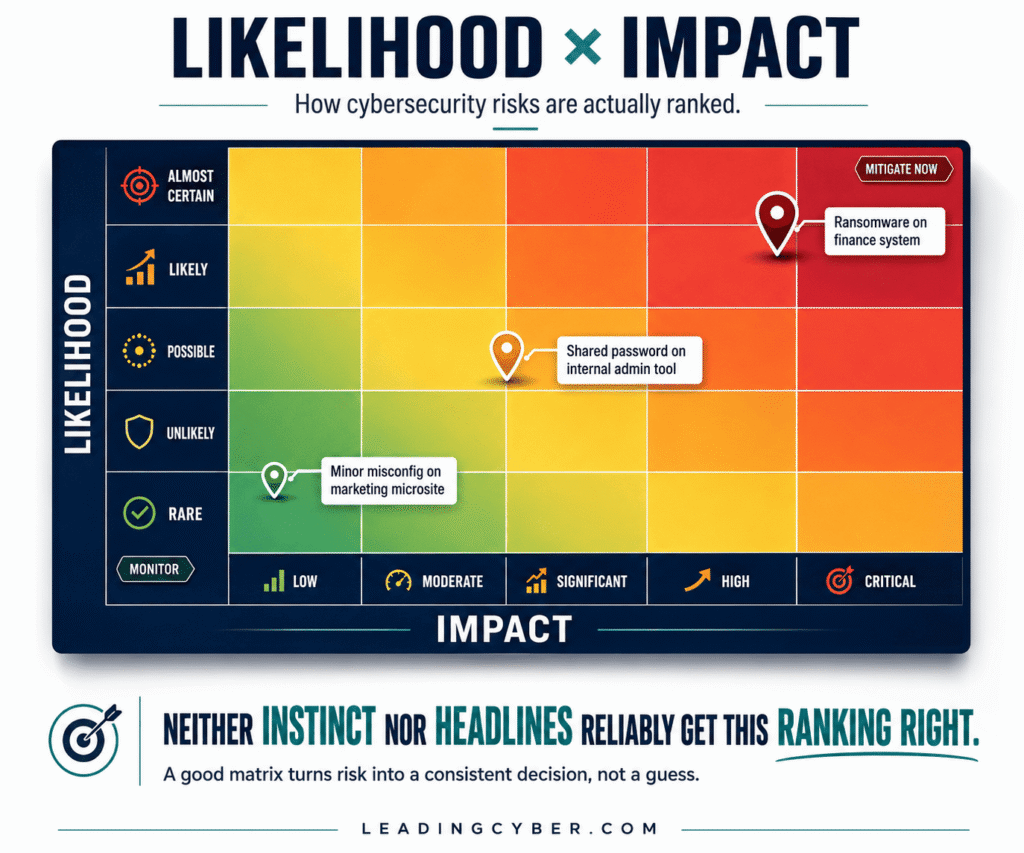
For each identified risk, estimate likelihood and impact. This is where risk stops being a feeling and becomes a number you can actually compare across wildly different scenarios — a ransomware attack on the finance system against a minor misconfiguration on a marketing microsite. Without this step, everything gets treated as equally urgent, which in practice means nothing does.
3. Treat
Decide what to do about each risk, using the four treatment options covered below. This is where risk management earns its keep as a leadership discipline rather than a purely technical one — treatment decisions are business decisions, made with business context, not defaulted to whatever the security team can technically implement fastest.
4. Monitor
Risk changes continuously, so the register has to be a living document, reviewed on a schedule and after major changes — a merger, a new product line, a significant vendor relationship. A risk register that was accurate a year ago and hasn’t been touched since is a historical document, not a management tool.
Risk = Likelihood × Impact
This is the formula underneath the entire discipline, and understanding it changes how you think about priorities. A risk with catastrophic impact but near-zero likelihood might rank below a risk with moderate impact that’s nearly certain to occur. Neither instinct nor headlines reliably get this ranking right — a formal assessment does.
Two flavors exist, and most mature programs use both:
- Qualitative assessment — likelihood and impact rated on scales (low/medium/high, or 1–5), fast to run and good enough for most day-to-day prioritization decisions.
- Quantitative assessment — likelihood and impact expressed in actual dollars, using methods like FAIR (Factor Analysis of Information Risk). Slower and more rigorous, and genuinely worth it for major decisions: board-level risk acceptance, cyber insurance conversations, and large capital investments in security infrastructure.
Start qualitative. Most organizations never need the full quantitative machinery for routine decisions — reserve it for the handful of risks big enough that a precise dollar figure actually changes the decision.
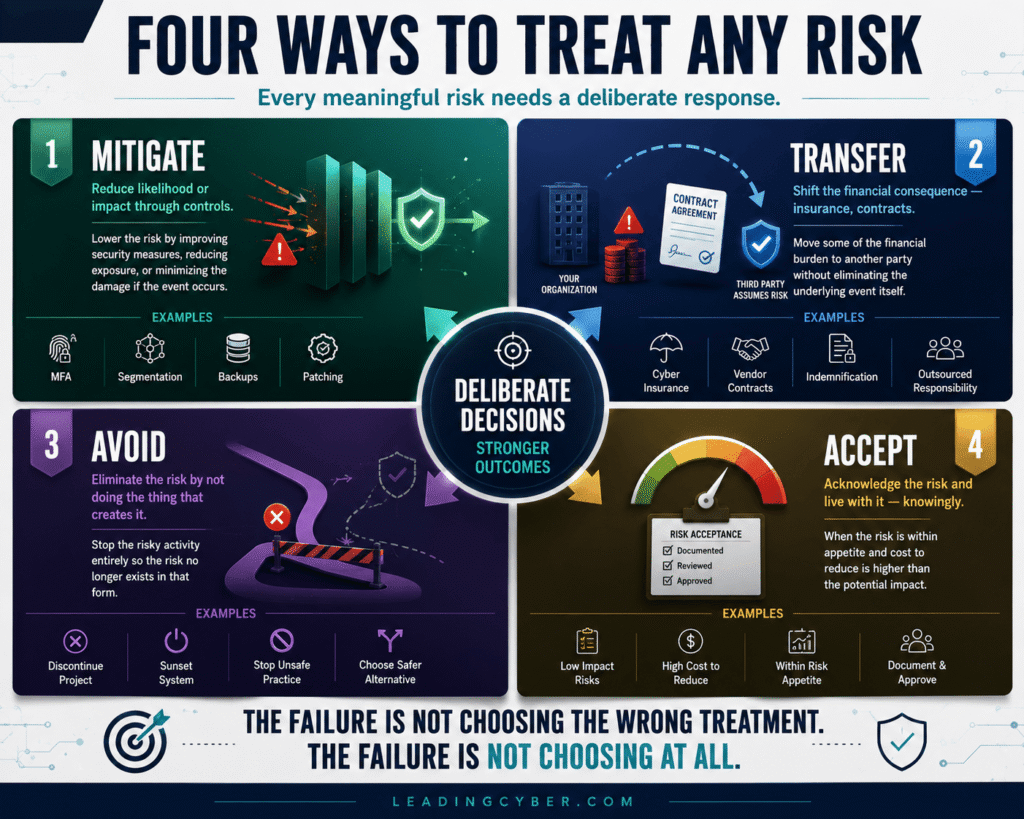
The Four Ways to Treat Any Risk
- Mitigate — reduce likelihood or impact through controls: patching, MFA, segmentation, training. The default instinct for most technical teams, and often the right one — but not the only option.
- Transfer — shift the financial consequence elsewhere, typically through cyber insurance or contractual risk-sharing with a vendor. This doesn’t reduce the risk itself; it changes who pays when it happens.
- Avoid — eliminate the risk by not doing the thing that creates it: not collecting a data type you don’t need, not standing up a system you can’t secure properly, not entering a market with regulatory exposure you’re not ready for.
- Accept — formally decide the risk is within tolerance and live with it, deliberately and on the record, rather than through silent neglect. This is legitimate risk management, not a failure of it — but only when it’s a documented, conscious choice.
The failure mode I see constantly isn’t choosing the wrong option — it’s never explicitly choosing at all. A risk that nobody formally decided to accept isn’t accepted; it’s just unaddressed, sitting there until an incident makes the decision for you.
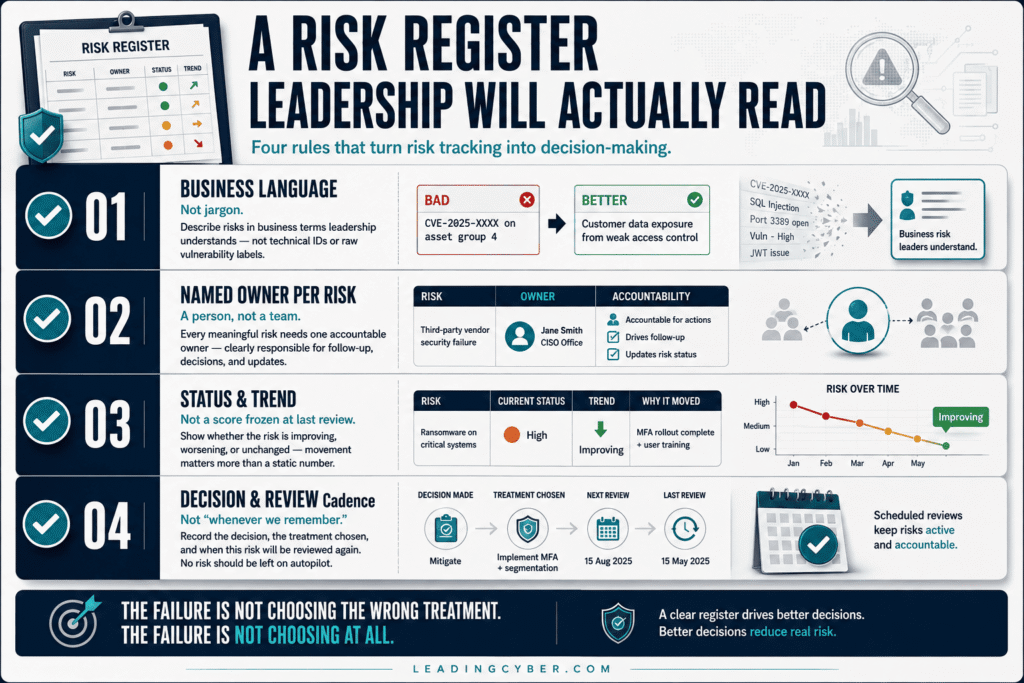
Building a Risk Register Leadership Will Actually Read
A risk register is the tool that makes all of this concrete. The ones that actually get used share a few traits:
- Business language, not jargon. “Customer data exposure from unpatched CRM” reads and lands differently than “CVE-2024-XXXX on prod-db-03,” even though they might describe exactly the same underlying risk.
- A named owner per risk. Not a team, not “IT” — a person accountable for tracking and reporting on that specific risk’s status.
- Current status and trend, not just a static score frozen at the last review. Is this risk increasing, decreasing, or holding steady since the last look?
- Short enough to actually review. A register with 400 rows gets skimmed once and ignored forever after. A register with the top 20-30 risks that matter gets read at every leadership meeting.
This is squarely the kind of ongoing ownership that a CISO or a vCISO exists to drive — someone has to own keeping this document alive, or it decays into exactly the historical artifact described above.
Where This Applies Across the Rest of Security
Risk management isn’t a separate discipline sitting apart from everything else in security — it’s the underlying logic that makes the rest of it coherent. Risk-based vulnerability management is this framework applied specifically to vulnerabilities. A data protection strategy is this framework applied specifically to data. Even a strong human firewall is a risk treatment — mitigating the likelihood side of the phishing risk through trained judgment rather than technology alone. Once you see risk management as the operating system underneath security decisions, the rest of the field stops looking like a list of unrelated tactics and starts looking like one coherent discipline.
For Leaders: Risk Appetite Is a Business Decision
The question underneath every risk management program is one only leadership can actually answer: how much risk is this organization willing to carry, in which areas, for what strategic reason? A hospital’s risk appetite around patient data availability looks nothing like a startup’s risk appetite around a beta feature’s data handling — and that’s exactly as it should be. Risk management done well doesn’t hand leadership a technical report to approve; it hands leadership a business decision to make, framed in terms they can actually reason about. This is the same thread running through people, process, and technology: the technical work supports the decision, but the decision itself belongs to people, made deliberately.
Key Takeaways
- Cybersecurity risk management is a continuous cycle — identify, assess, treat, monitor — not a one-time assessment
- Risk = likelihood × impact; formal assessment consistently beats gut instinct at ranking priorities correctly
- Every risk gets one of four treatments: mitigate, transfer, avoid, or accept — and “accept” must be a deliberate, documented decision
- A good risk register uses business language, names an owner per risk, and stays short enough to actually get read
- Risk management is the operating logic underneath vulnerability management, data protection, and security culture — not a separate discipline
Frequently Asked Questions
What is cybersecurity risk management?
Cybersecurity risk management is the ongoing process of identifying, assessing, and responding to risks to an organization’s information and systems, so that security investment targets what would actually hurt the business most. It’s a continuous cycle rather than a one-time assessment, because new systems, threats, and business changes constantly shift the risk picture.
What are the steps in the cybersecurity risk management process?
Four stages: identify the threats, vulnerabilities, and assets involved; assess each risk’s likelihood and impact to produce a comparable score; treat each risk by choosing to mitigate, transfer, avoid, or accept it; and monitor the risk register continuously, updating it on a schedule and after major business changes.
What is the difference between qualitative and quantitative risk assessment?
Qualitative assessment rates likelihood and impact on simple scales like low/medium/high, is fast to run, and works well for routine prioritization decisions. Quantitative assessment expresses likelihood and impact in actual dollar figures, using methods like FAIR, and is more rigorous but slower — best reserved for major decisions like board-level risk acceptance or large security investments.
What are the four ways to treat a cybersecurity risk?
Mitigate (reduce likelihood or impact through controls like patching or MFA), transfer (shift the financial consequence elsewhere, typically through cyber insurance), avoid (eliminate the risk by not doing the thing that creates it), and accept (formally and deliberately deciding to live with the risk). All four are legitimate; the failure mode is never making an explicit choice at all.
What is a cybersecurity risk register?
A cybersecurity risk register is a living document that tracks identified risks along with their likelihood, impact, treatment decision, and named owner. Effective ones use business language rather than technical jargon, stay short enough to actually be reviewed at leadership meetings, and show current status and trend rather than a static score frozen at the last assessment.
Who is responsible for cybersecurity risk management?
Day-to-day ownership typically sits with a CISO or, in smaller organizations, a virtual CISO, who maintains the risk register and drives the assessment cycle. But risk appetite and major treatment decisions — especially acceptance of significant risks — are ultimately business decisions that belong to executive leadership and the board, since they involve tradeoffs only leadership has the context to make.