
Here’s a pattern I’ve seen across every organization I’ve worked with: everyone agrees data is “the crown jewels,” and almost nobody can tell you where all of it lives, who can touch it, or when it was last backed up. A data protection strategy is the fix for that gap — not another tool purchase, but a deliberate answer to four questions: what data do we have, how much does each kind matter, what protects it, and who’s accountable when the answer is “nothing.”
This guide walks through the six pillars of a working strategy, the policy that makes it enforceable, the regulatory landscape leaders need to know at altitude, and the mistakes that quietly hollow out most data protection programs.
What Is a Data Protection Strategy?
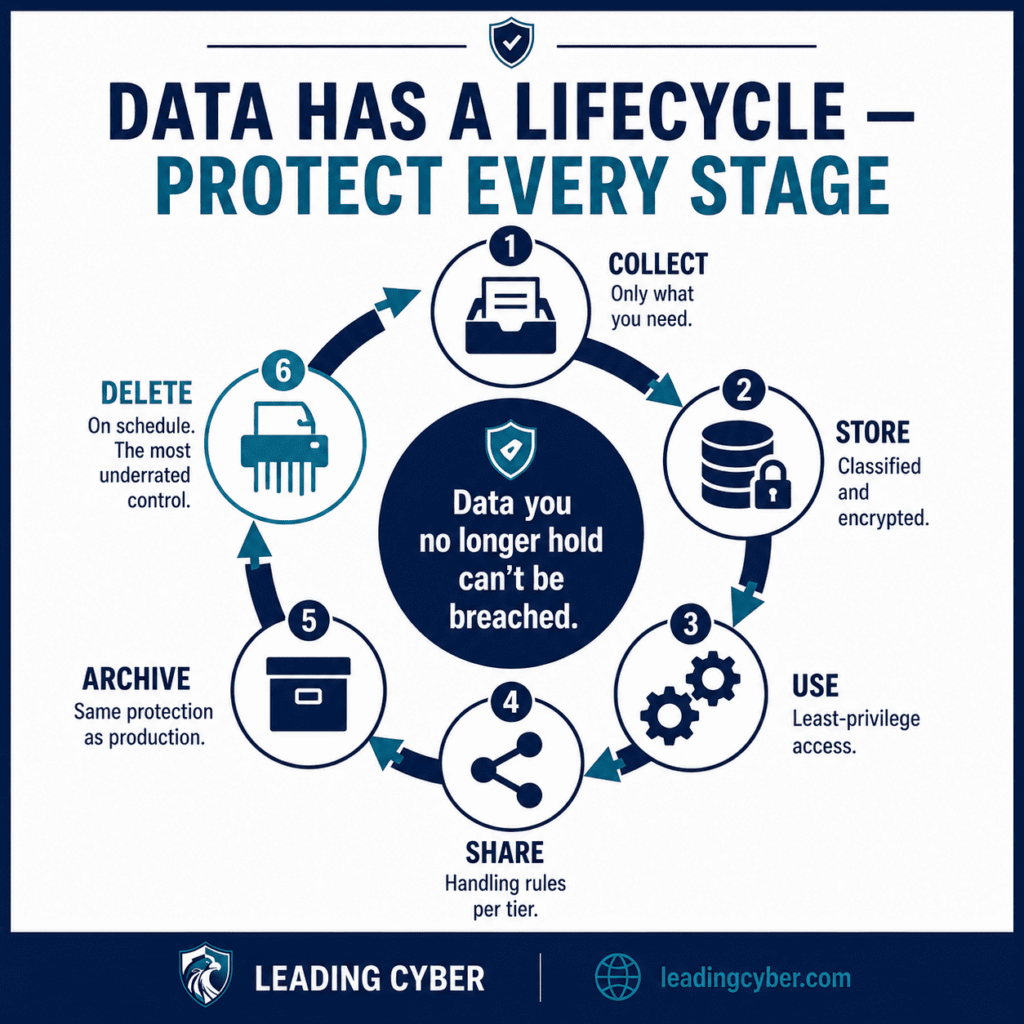
A data protection strategy is an organization’s deliberate plan for safeguarding its data throughout its lifecycle — defining what data exists and how sensitive it is, the controls that protect it (access, encryption, backup), how long it’s kept, and who is accountable for it — so that protection decisions are made by design rather than by accident.
The last clause is the whole point. Every organization protects data somehow; the question is whether the protection was chosen or just accumulated. Strategy means the sensitive customer database gets more protection than the lunch menu — on purpose, documented, and tested.
Start Here: You Can’t Protect What You Can’t Find
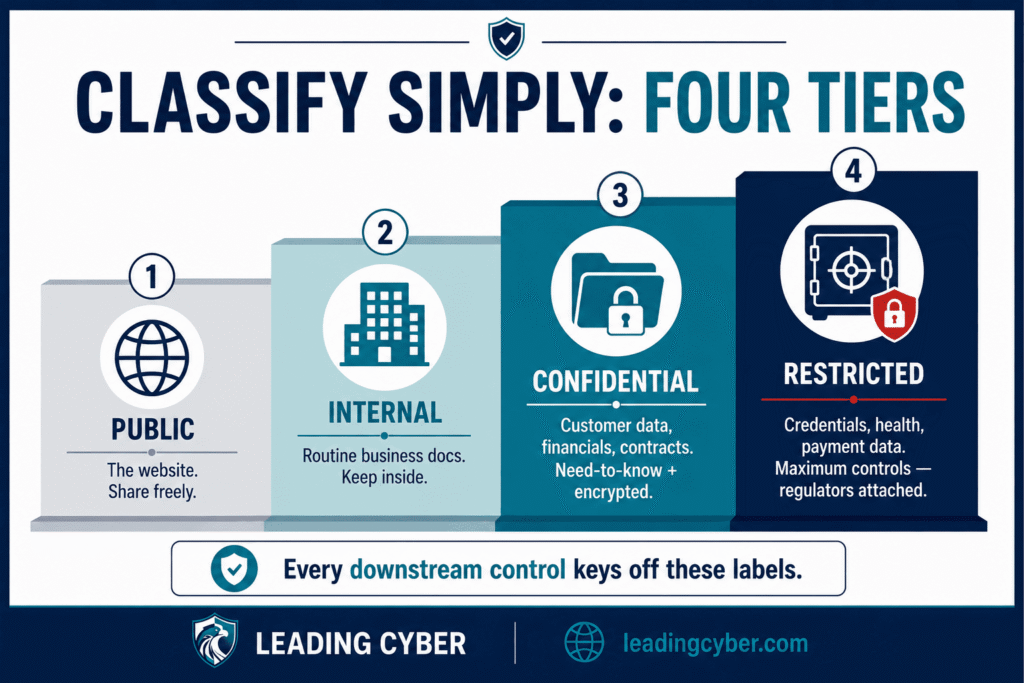
Before pillars and policies, the unglamorous foundation: data discovery and classification. Where does data actually live — databases, file shares, SaaS apps, laptops, that spreadsheet exported “just once” in 2023? And how sensitive is each kind?
Keep classification simple enough to survive contact with real employees. Four tiers cover nearly everyone: Public (the website), Internal (routine business docs), Confidential (customer data, financials, contracts), and Restricted (credentials, health records, payment data — the stuff with regulators attached). Every downstream control keys off these labels, which is why classification lives in your information security policy rather than in a slide deck.
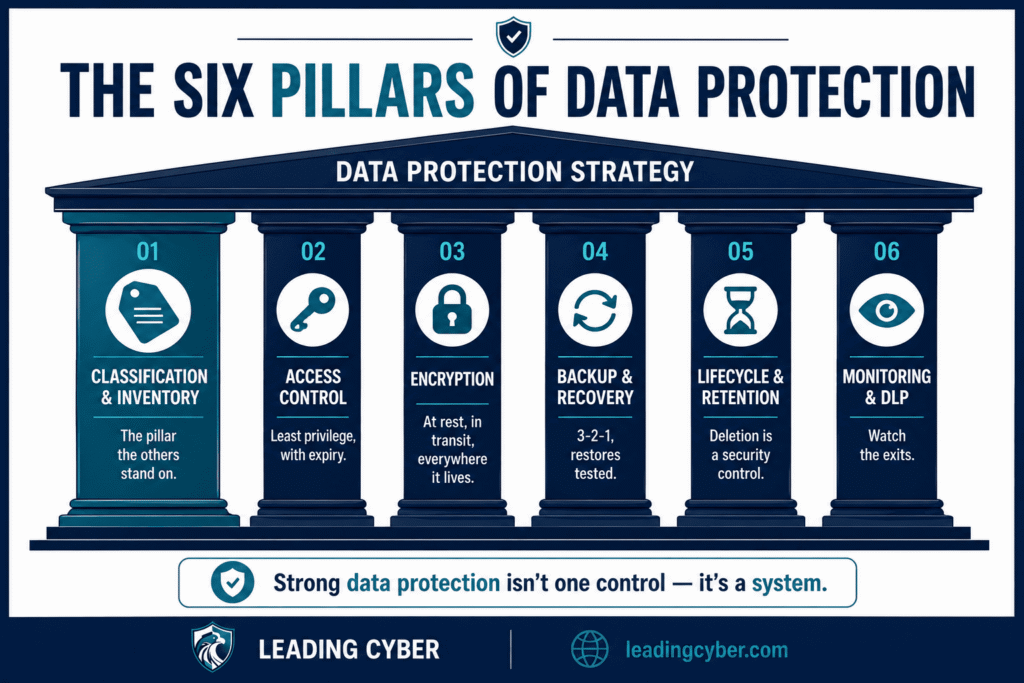
The Six Pillars of a Data Protection Strategy
1. Classification and Inventory
Covered above, listed first on purpose: it’s the pillar the other five stand on. An inventory that’s 80% right and maintained beats one that’s 100% right and abandoned.
2. Access Control
Least privilege, applied to data: people see what their role requires, nothing more, with access reviewed on a schedule and expiring when roles change. The contractor account that outlives the contract isn’t a hypothetical — I’ve found them in every environment I’ve assessed, and each one is a data protection failure waiting for a headline.
3. Encryption
At rest and in transit, using standard algorithms — nothing exotic. The comforting truth: the cryptography itself is the strongest link in your entire program, as I covered in the piece on mathematical attacks. Attackers don’t break AES; they find unencrypted copies, exported files, and leaked keys. So the encryption pillar is really a coverage question: is the sensitive data encrypted everywhere it lives, including the laptops and the backups?
4. Backup and Recovery
The 3-2-1 rule — three copies, two media, one offline — with restores actually tested. Backups are simultaneously a data protection control and your ransomware survival plan, which is why they anchor the cyber attack preparation checklist too. One nuance for this context: backups contain your most sensitive data by definition, so they inherit the same encryption and access requirements as production. An unencrypted backup is a breach on a shelf.
5. Lifecycle and Retention
The most underrated pillar: deletion is a security control. Data you no longer hold can’t be breached, subpoenaed, or leaked. Define how long each classification is kept, then actually delete on schedule — not “archive forever because storage is cheap.” Storage is cheap; breach notifications covering fifteen years of ex-customers are not.
6. Monitoring and Loss Prevention
Would you notice sensitive data leaving? Watch the egress points: large downloads, mass emails with attachments, sync to personal cloud accounts. Full DLP suites are heavy; start with alerts on the restricted tier and the obvious exits. Detection here is also your double-extortion defense — the theft happens before the ransom note.
The Data Protection Policy: Making It Enforceable
Strategy is direction; the data protection policy is the enforceable document underneath it. It’s typically a child of your main information security policy, and it should answer, in a few pages: the classification scheme and who assigns labels, handling rules per tier (where each class may be stored, sent, and shared), encryption requirements, retention and deletion schedules, rules for personal data specifically, and what happens when data is mishandled — including the no-blame path for reporting accidents. Accidentally emailing the wrong spreadsheet is recoverable in an hour if reported and a regulatory event if hidden for a month.
The Regulatory Layer: What Leaders Need at Altitude
You don’t need to memorize statutes; you need the shape of them. GDPR (EU) set the global template: lawful basis for processing, individual rights over data, breach notification deadlines, and real fines. CCPA/CPRA (California) and a growing patchwork of US state laws follow similar logic. HIPAA governs health data, PCI DSS payment cards. The common thread across all of them: know what personal data you hold, protect it proportionally, keep it no longer than needed, and be able to prove all three — which is to say, the six pillars above are the compliance program, wearing different paperwork.
Larger organizations, and any processing significant EU personal data, may also need a data protection officer (DPO) — an independent role that monitors compliance and serves as the regulator’s point of contact. Smaller organizations usually assign the accountability without the formal title.
The Leader’s Role: Where Strategies Actually Fail
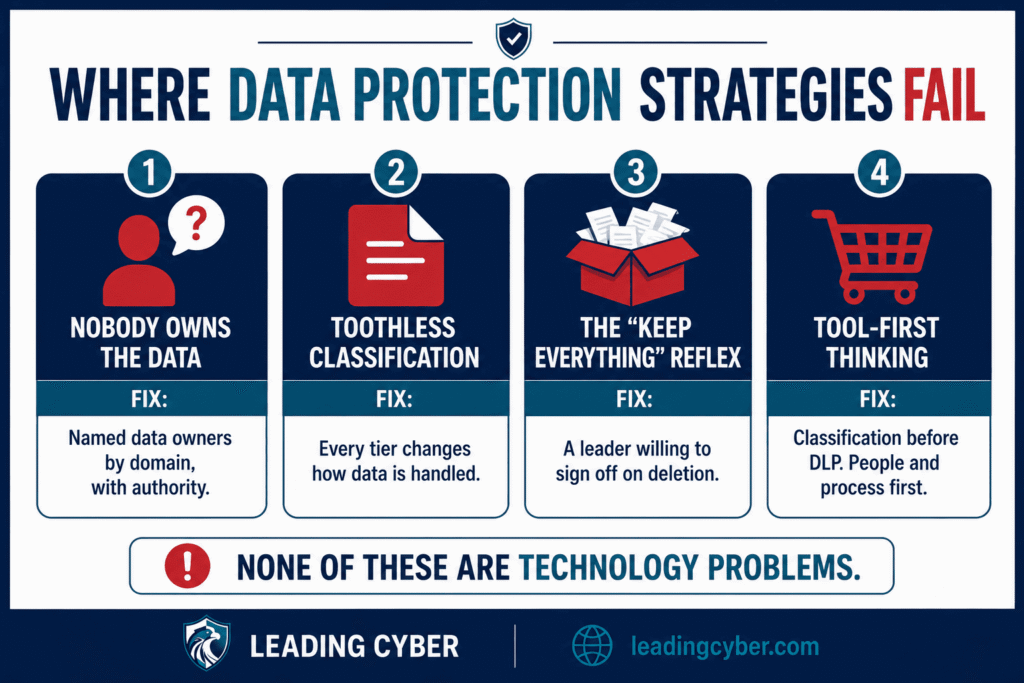
The failure points are rarely technical:
- Nobody owns the data. Systems have owners; data usually doesn’t. Assign data owners by domain — customer data, HR data, financials — with real authority.
- Classification without consequences. Labels that don’t change how data is handled are decoration. Every tier needs teeth.
- The “keep everything” reflex. Retention discipline requires a leader willing to approve deletion — a genuinely uncomfortable signature that pays compound interest.
- Tool-first thinking. DLP purchased before classification exists is a very expensive way to generate alerts nobody can interpret. As always, the sequencing is people and process first, technology in support.
Key Takeaways
- A data protection strategy answers four questions on purpose: what data exists, how much it matters, what protects it, and who’s accountable
- Classification is the foundation pillar — four simple tiers that drive every downstream control
- Encryption’s math is the strong link; coverage gaps, exports, and unencrypted backups are the weak ones
- Deletion is a security control: data you don’t hold can’t be breached
- Regulations differ in paperwork, not principle — the six pillars are the compliance program
- Strategies fail on ownership, not technology: name data owners and give classification teeth
Frequently Asked Questions
What is a data protection strategy?
A data protection strategy is an organization’s deliberate plan for safeguarding data throughout its lifecycle: identifying what data exists and classifying its sensitivity, applying proportional controls — access restrictions, encryption, tested backups — defining retention and deletion schedules, monitoring for data loss, and assigning clear ownership. The goal is protection by design rather than by accident.
What should a data protection policy include?
The classification scheme and who assigns labels, handling rules for each tier (where data may be stored, sent, and shared), encryption requirements, retention and deletion schedules, specific rules for personal data, breach and mishandling procedures with a no-blame reporting path, and named ownership. It typically lives as a child document under the organization’s main information security policy, in a few readable pages.
What is a data protection officer?
A data protection officer (DPO) is an independent role — required under GDPR for public bodies and organizations doing large-scale processing of personal data — who monitors compliance, advises on data protection obligations, and acts as the contact point for regulators and individuals. Smaller organizations often assign the responsibilities to an existing leader without the formal title, but the accountability still needs a name.
What is data classification?
Data classification is labeling data by sensitivity so protection can be proportional. A practical scheme uses four tiers: Public (freely shareable), Internal (routine business information), Confidential (customer data, financials, contracts), and Restricted (credentials, health and payment data). Each tier carries defined handling rules — which is what separates working classification from decorative labels.
What is the difference between data protection, data security, and data privacy?
They overlap but aim differently: data security protects data from unauthorized access and attacks (encryption, access control, monitoring); data privacy governs the proper collection and use of personal data and individuals’ rights over it; and data protection is the umbrella spanning both — keeping data safe, used appropriately, available when needed, and recoverable when things go wrong.
How do you build a data protection strategy?
In order: discover and inventory your data, classify it into simple tiers, assign named data owners, apply controls proportional to each tier — least-privilege access, encryption at rest and in transit, 3-2-1 backups with tested restores — set retention schedules and actually delete on them, add monitoring on the sensitive tiers and egress points, and write it into an enforceable policy with an annual review. Classification first; tools last.