Here’s an uncomfortable number: research has consistently found that only a small fraction of published vulnerabilities — mid-single digits, percent-wise — ever get exploited in the wild. Yet most security teams treat all 40,000 findings on the scan report as equally urgent, burn out chasing CVSS scores, and still miss the one flaw attackers actually use. Risk based vulnerability management exists to fix exactly that.
I covered the full vulnerability management lifecycle in a separate guide — this article goes deep on its hardest stage: prioritization. What risk-based vulnerability management is, why CVSS-only ranking quietly fails, the four factors that actually predict danger, and a five-step path to switch over.
What Is Risk-Based Vulnerability Management?
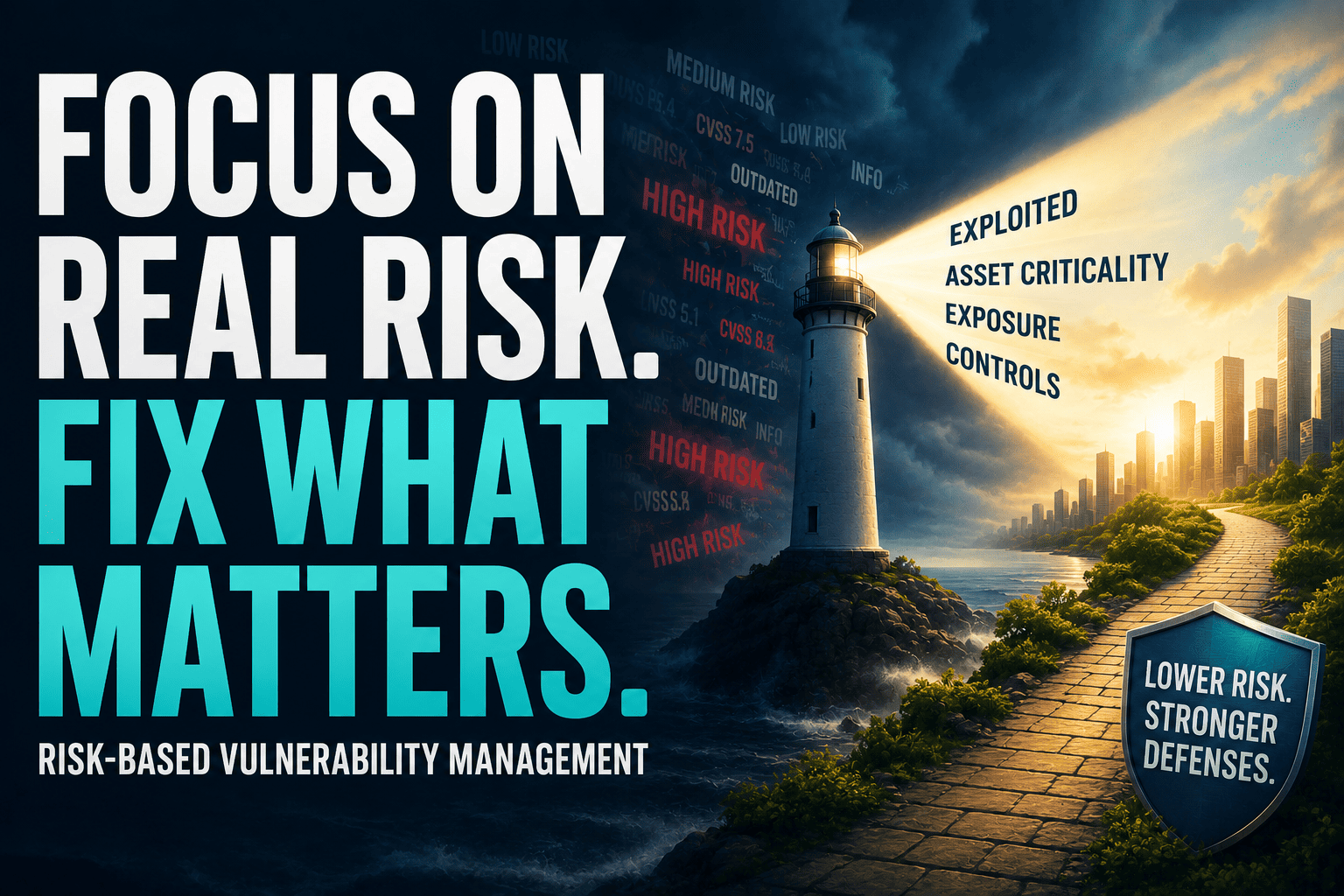
Risk-based vulnerability management (RBVM) is an approach that prioritizes vulnerabilities by the real-world risk they pose to your specific organization — combining severity with active exploitation data, asset criticality, and exposure — instead of ranking them by CVSS score alone.
The shift sounds subtle. In practice it’s the difference between a to-do list of 12,000 “criticals” and a short list of the 50 findings that genuinely matter this week. Same scanner, same findings — completely different program.

Why CVSS-Only Prioritization Fails
CVSS isn’t wrong — it’s incomplete. The score measures theoretical severity: how bad this flaw could be, in the abstract, for a generic organization. What it doesn’t know is anything about you.
Three blind spots do the damage:
- CVSS doesn’t know what attackers are doing. A 9.8 nobody has ever weaponized sits above a 6.5 being mass-exploited this week. Ranked by score alone, you’ll patch the wrong one first.
- CVSS doesn’t know your assets. The same vulnerability scores identically on your internet-facing payment platform and the isolated lab server nobody can reach. Your risk on those two machines is nowhere near identical.
- CVSS floods the zone. A large share of published CVEs score High or Critical. When half the report is “critical,” the word stops meaning anything — and teams start ignoring the report entirely. I’ve watched that exact numbness set in on infrastructure teams, and it’s rational: nobody can patch everything, so a list that demands everything gets nothing.
The Four Factors That Actually Predict Risk
RBVM replaces the single score with a handful of questions, asked per finding:
1. Is It Being Exploited?
The strongest signal there is. Two free resources answer it: CISA’s Known Exploited Vulnerabilities (KEV) catalog — a running list of flaws confirmed exploited in the wild — and EPSS (the Exploit Prediction Scoring System), which estimates the probability a vulnerability will be exploited soon. Anything in KEV jumps the queue. No debate needed.
2. How Critical Is the Asset?
A vulnerability inherits the importance of what it lives on. The domain controller, the payment platform, the OT system running a water treatment process — findings there carry weight that a test box never will. This requires tiering your assets, which is unglamorous work your inventory (lifecycle stage 1) should already support.
3. Is It Exposed?
Internet-facing beats internal beats isolated. An attacker needs a path; exposure is the path. A flaw reachable by anyone on Earth is a different animal from the same flaw behind three network segments.
4. What Controls Already Stand in the Way?
Compensating controls change the math. The unpatched system behind strict segmentation with no inbound access might reasonably wait; without those controls, the identical finding is urgent. This factor is also what makes RBVM workable in environments where patching is genuinely hard — in my utility work, some systems had maintenance windows twice a year, and risk context was the only honest way to decide what could wait until then.

How to Implement RBVM in 5 Steps
Step 1: Tier Your Assets
Three tiers is enough to start: crown jewels (business-critical, sensitive data, safety-relevant), standard, and low-value. Perfect is the enemy here — a rough tiering you actually use beats a precise one that takes a year to build.
Step 2: Enrich Findings With Threat Intelligence
Feed KEV and EPSS data into your findings. Most modern scanners and vulnerability platforms can pull both automatically; if yours can’t, KEV is a downloadable list and EPSS scores are free via API. This single step reshuffles your priorities more than anything else on this list.
Step 3: Re-Rank With Context
Combine the factors — exploitation status, asset tier, exposure, controls — into a risk ranking. Whether you use a platform’s built-in risk score or a simple internal formula matters less than consistency. The output you want: a short, defensible “fix now” list that engineers believe in.
Step 4: Set Risk-Based SLAs
Replace “criticals in 7 days” with SLAs tied to risk: KEV-listed on a crown-jewel asset — 48 hours; exploited or exposed — 7 days; everything else on a schedule that matches its actual danger. Fewer emergencies, and the emergencies are real.
Step 5: Report Risk Reduction, Not Counts
Stop reporting “closed 3,000 vulnerabilities” — it invites teams to farm easy findings. Report risk: exploited-vulnerability exposure eliminated, crown-jewel findings past SLA, risk trend by business unit. Leadership understands that language, and it rewards the right behavior. This is also where the program stops being an IT chore and becomes what it should have been all along — a business risk function, which is ultimately a people and process alignment problem, not a tooling one.

Traditional vs. Risk-Based: The Same Scan, Two Programs
The contrast in practice:
- Ranking: traditional sorts by CVSS score; RBVM sorts by exploitation, asset value, and exposure
- The list: traditional produces thousands of “urgent” items; RBVM produces dozens of genuinely urgent ones
- SLAs: traditional ties deadlines to severity labels; RBVM ties them to actual risk
- Reporting: traditional counts closed tickets; RBVM measures risk removed
- Team morale: traditional breeds numbness (“everything is critical”); RBVM restores trust in the list
Worth saying plainly: RBVM doesn’t replace CVSS. It demotes it — from the whole answer to one input among four.
Key Takeaways
- Only a small fraction of published vulnerabilities are ever exploited — prioritizing by CVSS alone means treating the other 95% as equally urgent
- Risk-based vulnerability management ranks findings by exploitation status, asset criticality, exposure, and existing controls
- CISA KEV and EPSS are free and reshuffle your priorities more than any paid tool
- Risk-based SLAs make deadlines meaningful again: 48 hours for KEV-on-crown-jewels beats “7 days for all criticals”
- Report risk reduced, not tickets closed — it changes what teams optimize for

Frequently Asked Questions
What is risk-based vulnerability management?
Risk-based vulnerability management (RBVM) is an approach that prioritizes security findings by the actual risk they pose to your organization — combining severity with real-world exploitation data, asset criticality, exposure, and existing controls — rather than ranking by CVSS score alone. The goal is a short, defensible list of what to fix first, instead of thousands of equally “critical” findings.
What is the difference between risk-based and traditional vulnerability management?
Traditional programs rank findings by CVSS severity and set deadlines by severity label, producing huge lists where everything looks urgent. RBVM adds context — is it being exploited, what asset is it on, is it exposed, what controls exist — producing a much shorter priority list, risk-tied SLAs, and reporting based on risk reduced rather than tickets closed. The scan is the same; the program built on it is not.
What is EPSS?
EPSS — the Exploit Prediction Scoring System, maintained by FIRST — estimates the probability that a given vulnerability will be exploited in the wild in the near future, expressed as a score between 0 and 1. It complements CVSS: CVSS says how bad exploitation would be, EPSS says how likely it is. Scores are free and available via API, making EPSS one of the easiest RBVM upgrades to adopt.
What is the CISA KEV catalog?
The Known Exploited Vulnerabilities catalog is a free, continuously updated list from CISA of vulnerabilities confirmed to be exploited in the wild. It’s the strongest single prioritization signal available: if a finding in your environment appears in KEV, it jumps the remediation queue. US federal agencies are required to fix KEV entries by set deadlines, and private organizations increasingly borrow that discipline.
How do you prioritize vulnerabilities?
Ask four questions per finding: Is it being actively exploited (check KEV and EPSS)? How critical is the asset it sits on? Is that asset exposed to the internet? What compensating controls already reduce the danger? A medium-severity flaw that’s exploited, exposed, and on a crown-jewel system outranks an unexploited critical on an isolated machine — context beats score.
Does risk-based vulnerability management replace CVSS?
No — it demotes CVSS from the entire answer to one input among several. Severity still matters; it just stops being the only thing that matters. Most RBVM implementations keep CVSS as the baseline severity measure and layer exploitation likelihood, asset value, and exposure on top of it to produce the final ranking.