Every organization I’ve worked with owns a vulnerability scanner. Far fewer own a working vulnerability management lifecycle — and the difference shows up the same way every time: a report with 40,000 findings that nobody reads, and an unpatched server that everyone assumed someone else was handling.
Scanning is easy. Management is the hard part. So in this guide I’ll walk through the vulnerability management lifecycle stage by stage — six of them — plus the two things that decide whether the cycle actually spins: a policy that assigns ownership, and metrics that tell you the truth. This is written from the trenches of public-sector IT and utility environments, where “just patch everything” was never an option.
What Is Vulnerability Management?
Vulnerability management is the continuous process of discovering, prioritizing, remediating, and reporting on security weaknesses across an organization’s systems — before attackers can exploit them. The key word is continuous. A one-time scan is a snapshot; vulnerability management is a loop that never stops, because new vulnerabilities are published daily and your environment changes weekly.
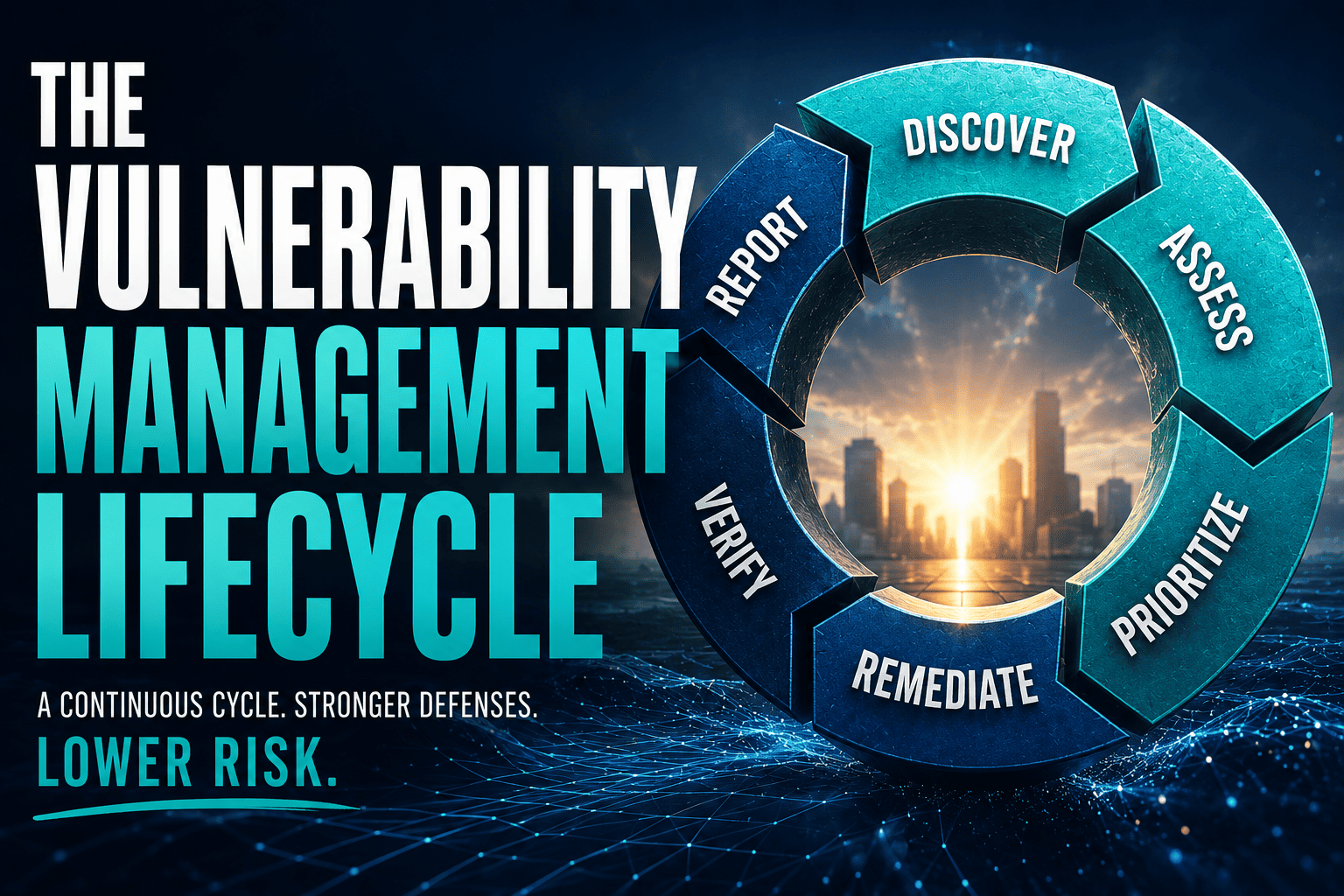
That loop has a name — the vulnerability management lifecycle — and while some frameworks draw it with five stages and others with six, the underlying work is the same. Here’s the six-stage version I find clearest.

The 6 Stages of the Vulnerability Management Lifecycle
Stage 1: Discover — Build the Asset Inventory
You can’t protect what you don’t know exists. Stage one is a complete, current inventory of everything on your network — servers, endpoints, cloud instances, network gear, IoT devices, and the forgotten test box someone stood up three years ago. That last one isn’t a joke; forgotten assets are where incidents are born. In my experience, the inventory is the least glamorous stage and the one that quietly determines whether every other stage works.
Stage 2: Scan and Assess — Find the Weaknesses
Now the scanners earn their license fees: scheduled, authenticated scans across the inventory, catching missing patches, misconfigurations, weak protocols, and end-of-life software. Authenticated scans matter more than most teams realize — an unauthenticated scan sees the building from the street, while an authenticated one walks the hallways. Validate the results too. Every false positive you chase burns credibility with the teams who have to do the fixing.
Stage 3: Prioritize — Rank by Real Risk, Not Raw Scores
Here’s where most programs drown. A mid-size scan returns thousands of findings, and treating them as a flat to-do list guarantees failure. Prioritization means combining severity (CVSS) with context: Is the vulnerability actually being exploited in the wild? Is the asset exposed to the internet? Does it hold sensitive data? A medium-severity flaw on your public payment server outranks a critical one on an isolated lab machine — every time. This context-driven approach has a name, risk-based vulnerability management, and it deserves its own article.
Stage 4: Remediate — Fix, Mitigate, or Accept (With a Name Attached)
Every prioritized finding gets one of three outcomes: fix it (patch, reconfigure, upgrade), mitigate it (compensating controls when patching isn’t possible — common in utility and OT environments where a server reboot means a service outage), or accept it (documented, time-boxed, signed by someone with authority). What it never gets is silence. Each finding needs an owner and a deadline, because “the team” owning something means nobody owns it — the same ownership problem that sits at the root of most security failures.
Stage 5: Verify — Trust, Then Confirm
A closed ticket is not a fixed vulnerability. Rescan after remediation to confirm the fix actually landed — patches fail silently, get rolled back, or miss half the affected systems more often than anyone likes to admit. Verification is also where you catch recurrence: the “fixed” vulnerability that reappears next quarter because an old image got redeployed.
Stage 6: Report and Improve — Close the Loop
The final stage feeds the next cycle. Report trends to leadership in business language (risk reduced, exposure windows shortened — not raw CVE counts), review what the cycle taught you, and tune the process. Which assets keep generating findings? Which teams miss SLAs, and why? A lifecycle that doesn’t learn is just a treadmill.

The Vulnerability Management Policy: Who Does What, By When
The lifecycle describes the work. The vulnerability management policy makes it enforceable. Without one, every patch becomes a negotiation; with one, it’s just the rule. A solid policy fits on a few pages and answers five questions:
- Scope — which systems, environments, and cloud assets are covered (answer: all of them, including the exceptions everyone wants)
- Roles — who scans, who fixes, who approves risk acceptance, who reports to leadership
- Remediation SLAs — deadlines by severity, for example: critical in 7 days, high in 30, medium in 90
- Exception handling — how risk gets accepted, by whom, and when the acceptance expires (never “forever”)
- Scanning cadence — how often each environment gets assessed, and what triggers an out-of-cycle scan
One hard-earned tip: get the SLAs signed by leadership before the first big scan lands. Negotiating deadlines while 40,000 findings glow on a dashboard is a much worse conversation.
Vulnerability Management Metrics That Actually Matter
You can’t improve the lifecycle without measuring it — but measure the right things. Raw vulnerability counts mostly track how good your scanner is, not how safe you are. These five tell the real story:
- Mean time to remediate (MTTR) — how long from discovery to verified fix, split by severity. The single most honest number in the program.
- SLA compliance rate — what percentage of findings get fixed within policy deadlines
- Scan coverage — what percentage of the asset inventory is actually being assessed (gaps here invalidate everything else)
- Vulnerability age — how old your open criticals are; a critical that’s 200 days old is a standing invitation
- Recurrence rate — how many “fixed” findings come back, which exposes broken processes upstream

Why Vulnerability Management Programs Fail
After years around these programs, I can tell you the failure modes are rarely technical. The scanner works. What breaks:
- Nobody owns remediation. Security finds, IT fixes — and the handoff between them is where findings go to die.
- Prioritization by raw count. Teams chase the number of findings down instead of the risk down, fixing 500 trivia while the one exploitable critical waits.
- No leadership air cover. Patch windows mean downtime, and without executive backing, operations wins every argument. This is a leadership problem before it’s a technical one — the same pattern I wrote about in what I got wrong leading my first IT team.
- The loop never closes. Scans happen, reports get emailed, and nothing feeds back into improvement. That’s a lifecycle in name only.
Key Takeaways
- The vulnerability management lifecycle runs in six stages: discover, assess, prioritize, remediate, verify, report — and then it starts again
- The inventory (stage 1) quietly decides whether everything else works
- Prioritize by real risk — exploitability and exposure — not by raw CVSS score alone
- Every finding gets an owner, a deadline, and one of three outcomes: fix, mitigate, or accept. Never silence
- A short policy with signed SLAs beats a long one nobody follows, and five honest metrics beat fifty vanity ones

Frequently Asked Questions
What is the vulnerability management lifecycle?
The vulnerability management lifecycle is the continuous, repeating process organizations use to find and fix security weaknesses: discovering assets, scanning and assessing them, prioritizing findings by real risk, remediating or mitigating them, verifying the fixes worked, and reporting results to improve the next cycle. It’s a loop rather than a project, because new vulnerabilities appear daily and environments change constantly.
What are the steps in the vulnerability management life cycle?
Six steps: (1) Discover — build a complete asset inventory; (2) Scan and assess — run authenticated scans to find weaknesses; (3) Prioritize — rank findings by severity, exploitability, and exposure; (4) Remediate — fix, mitigate, or formally accept each finding with an owner and deadline; (5) Verify — rescan to confirm fixes landed; (6) Report and improve — feed results into the next cycle. Some frameworks compress these into five stages, but the work is identical.
What is vulnerability management?
Vulnerability management is the ongoing practice of identifying, evaluating, prioritizing, and fixing security weaknesses across an organization’s systems before attackers can exploit them. It differs from a one-off vulnerability assessment the way fitness differs from a single doctor’s visit — the value comes from the continuous cycle, not the snapshot.
What should a vulnerability management policy include?
Five essentials: the scope of covered systems (including cloud and exceptions), roles and responsibilities for scanning, fixing, and approving risk acceptance, remediation SLAs by severity (for example, critical within 7 days, high within 30), a formal exception process with expiration dates, and scanning cadence for each environment. Short and enforced beats long and ignored.
How often should vulnerability scans be run?
Continuous or weekly scanning is the modern baseline for most environments, with monthly as a minimum for lower-risk segments — plus out-of-cycle scans after major changes and when critical vulnerabilities make headlines. External-facing assets deserve the most frequent attention, since they’re exposed to everyone. The honest answer: scan as often as your team can actually process the results.
What is the difference between vulnerability management and vulnerability assessment?
A vulnerability assessment is a point-in-time evaluation — one scan, one report, one snapshot of your weaknesses. Vulnerability management is the permanent program wrapped around it: the repeating lifecycle of discovery, prioritization, remediation, verification, and improvement. An assessment tells you where you stand today; management changes where you stand next quarter.