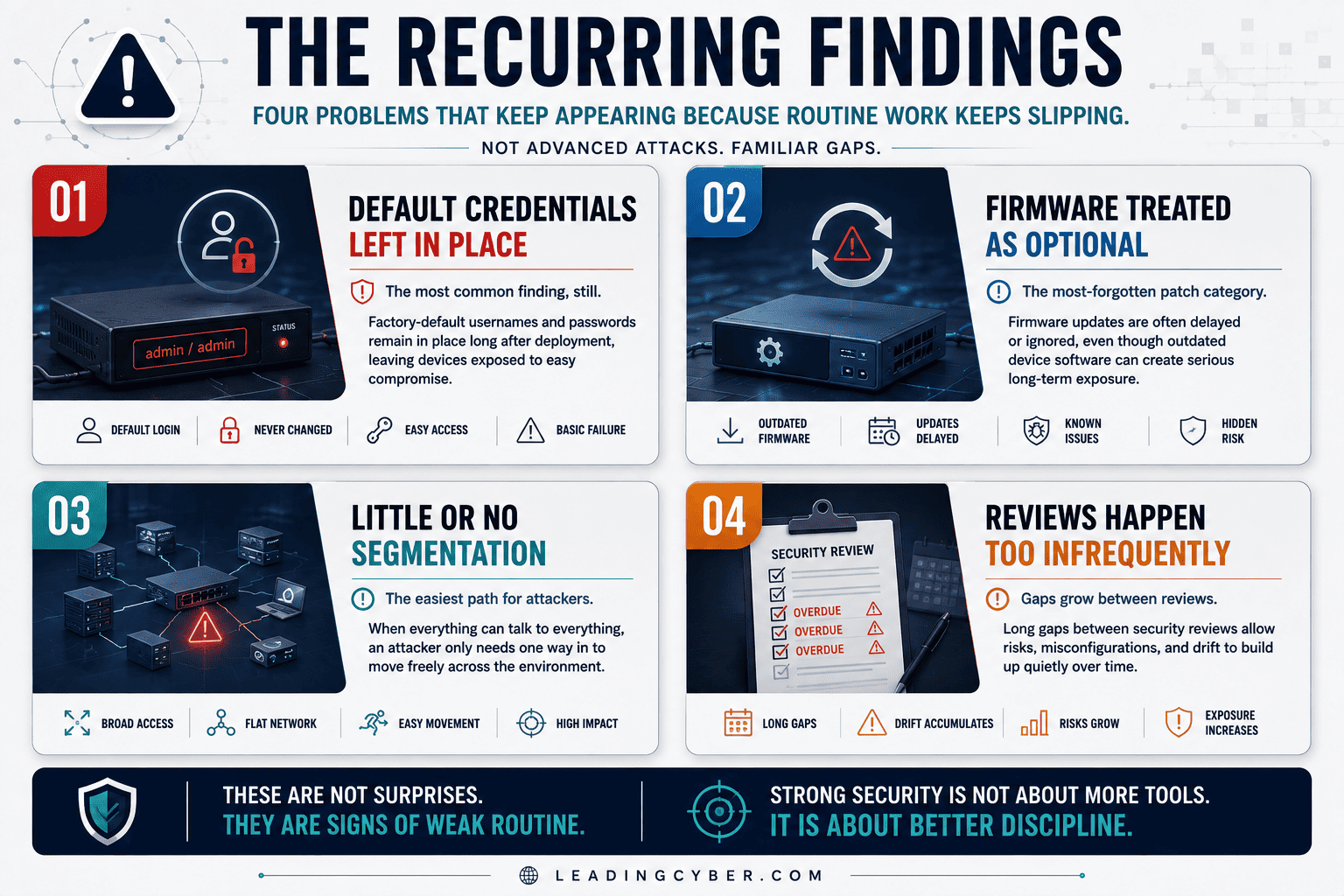

I’ve written before about running a network security assessment and building real network security monitoring. Both are essential, and both are also, on their own, incomplete. An assessment tells you where you stood on the day you ran it. Monitoring tells you what’s happening right now. Neither one is the job of actually running the network day to day — deciding what gets patched this week, who gets access, which device finally gets retired. That ongoing work has a name: network security management.
This guide covers what network security management actually is, how it relates to its two closest relatives, the core components of a real program, and the staffing decision most organizations eventually have to make.
What Is Network Security Management?
Network security management is the ongoing operational discipline of maintaining, configuring, and governing an organization’s network security controls — access, devices, segmentation, and policy enforcement — as a continuous responsibility rather than a periodic project.
The word “ongoing” is doing the same work here it does everywhere else in this field. An assessment is a snapshot. Monitoring is a watchtower. Management is the actual job of running the thing — the daily decisions, the patch that has to go out this week, the access request that needs an answer today, not next quarter’s review cycle.
Management vs. Assessment vs. Monitoring
These three terms get used almost interchangeably in casual conversation, and that’s a mistake worth correcting, because each one answers a genuinely different question:
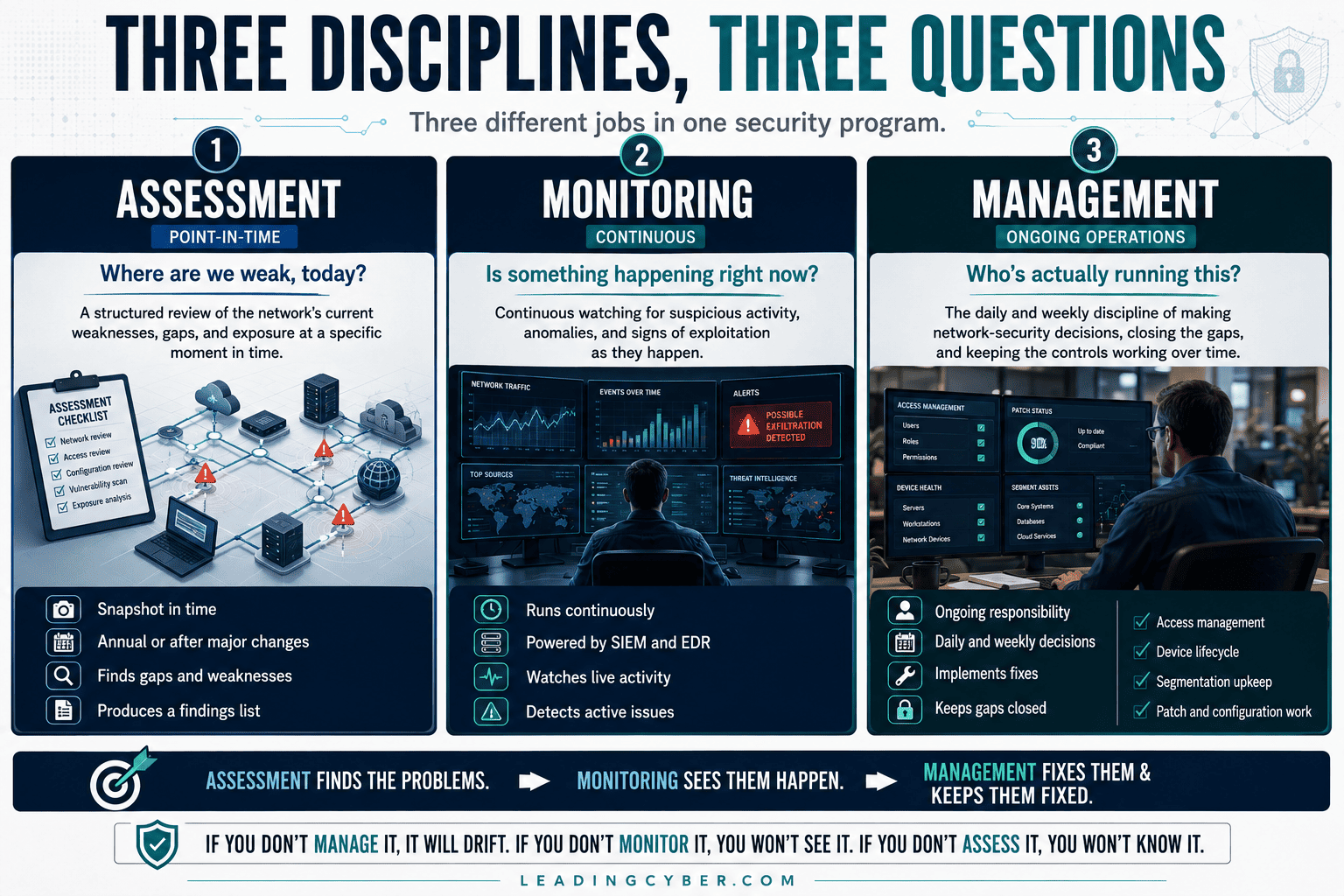
- Network security assessment — a point-in-time evaluation answering “where are we weak, right now, today?” Run it annually, after major changes, or before compliance pushes.
- Network security monitoring — continuous watching, answering “is something happening right now that shouldn’t be?” Runs constantly, powered by SIEM, EDR, and the rest of the monitoring toolkit.
- Network security management — the ongoing operational job, answering “who’s actually running this, and are the decisions getting made?” It’s the daily and weekly work of implementing what the assessment found and acting on what monitoring reveals.
Here’s the relationship in one line: assessment finds the gaps, monitoring watches for exploitation, and management is the discipline that actually closes the gaps and keeps them closed. Skip management and the other two become theater — a report nobody acts on, and alerts nobody has the bandwidth to resolve.
The Core Components of Network Security Management
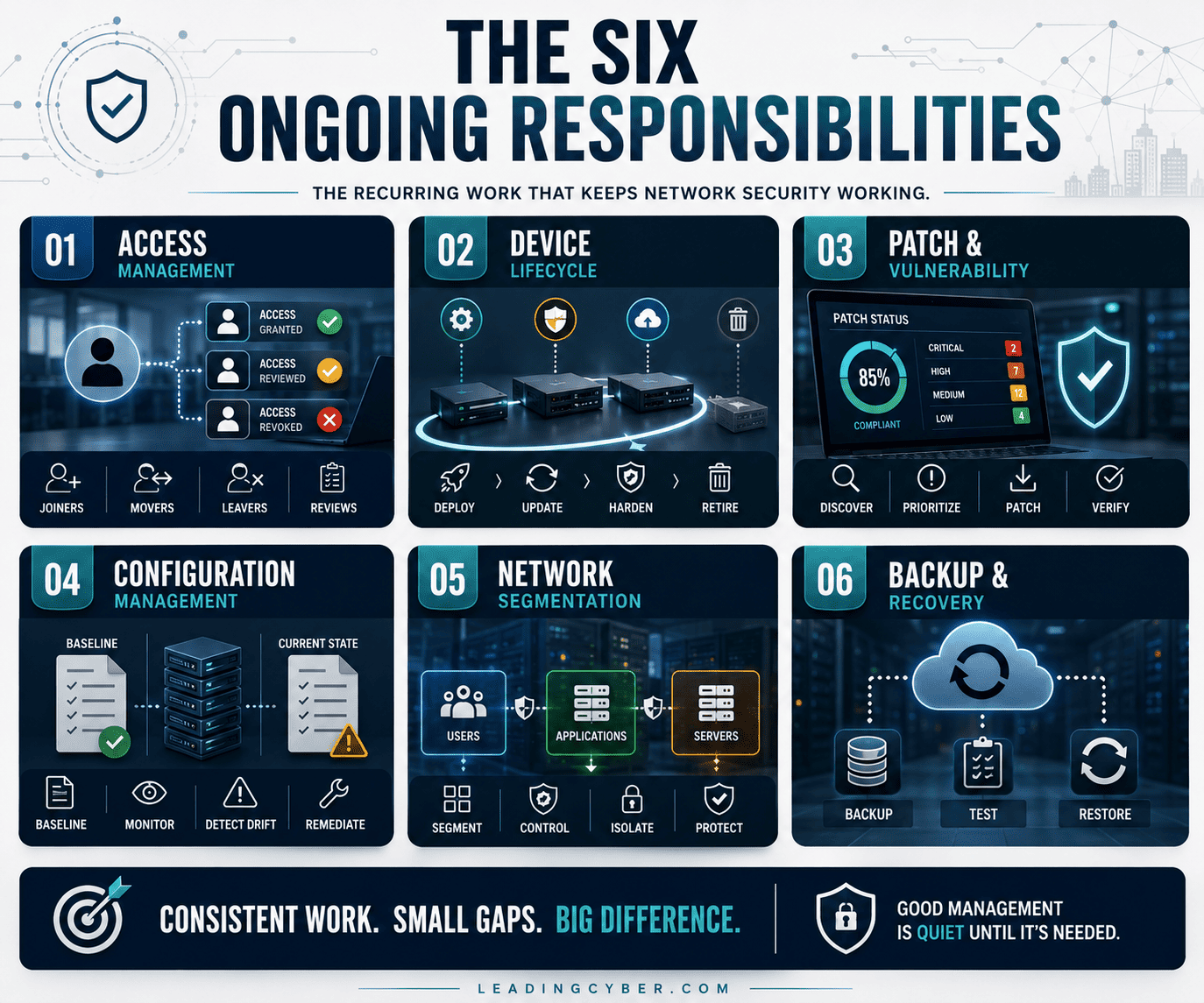
- Access management — granting, reviewing, and revoking network access on an ongoing basis, not just at onboarding. This is where the “forgotten contractor account” problem I keep running into on assessments actually gets prevented, rather than just discovered later.
- Device lifecycle management — tracking every firewall, switch, and router from deployment to retirement, including firmware currency and configuration drift over time. Devices don’t stay configured the way they were set up; someone has to actively keep them that way.
- Segmentation upkeep — as the network grows, new systems and vendors get added constantly, and each addition either respects the segmentation design or quietly erodes it. Someone has to be the person who says no to the convenient shortcut.
- Policy enforcement — making sure the information security policy‘s network-related rules are actually happening in practice, not just written down somewhere.
- Patch and configuration management — the unglamorous weekly grind of applying updates and fixing drift before it becomes the finding in next year’s assessment.
- Incident response coordination — network security management owns the operational muscle memory that makes incident response actually work when something goes wrong, rather than discovering the runbook is stale mid-crisis.
Building a Network Security Management Program
- Start from your last assessment’s findings. If you’ve run one, it’s already telling you what management has been neglecting. Treat the findings list as the initial management backlog, not a report to file away.
- Assign explicit ownership. Someone has to own this — not “the IT team” in the abstract, but a named person with authority to make network changes and the accountability when things drift.
- Set a maintenance cadence. Weekly patch windows, monthly access reviews, quarterly segmentation checks. Management fails most often not from lack of skill but from lack of a calendar — good intentions without a schedule quietly evaporate.
- Feed monitoring alerts back into management action. An alert that doesn’t trigger a management response is just noise with extra steps. The monitoring program and the management program have to talk to each other constantly, not sit in separate silos.
- Re-assess periodically to check your own work. The next annual assessment is, in a real sense, grading how well management performed over the past year.
Common Challenges
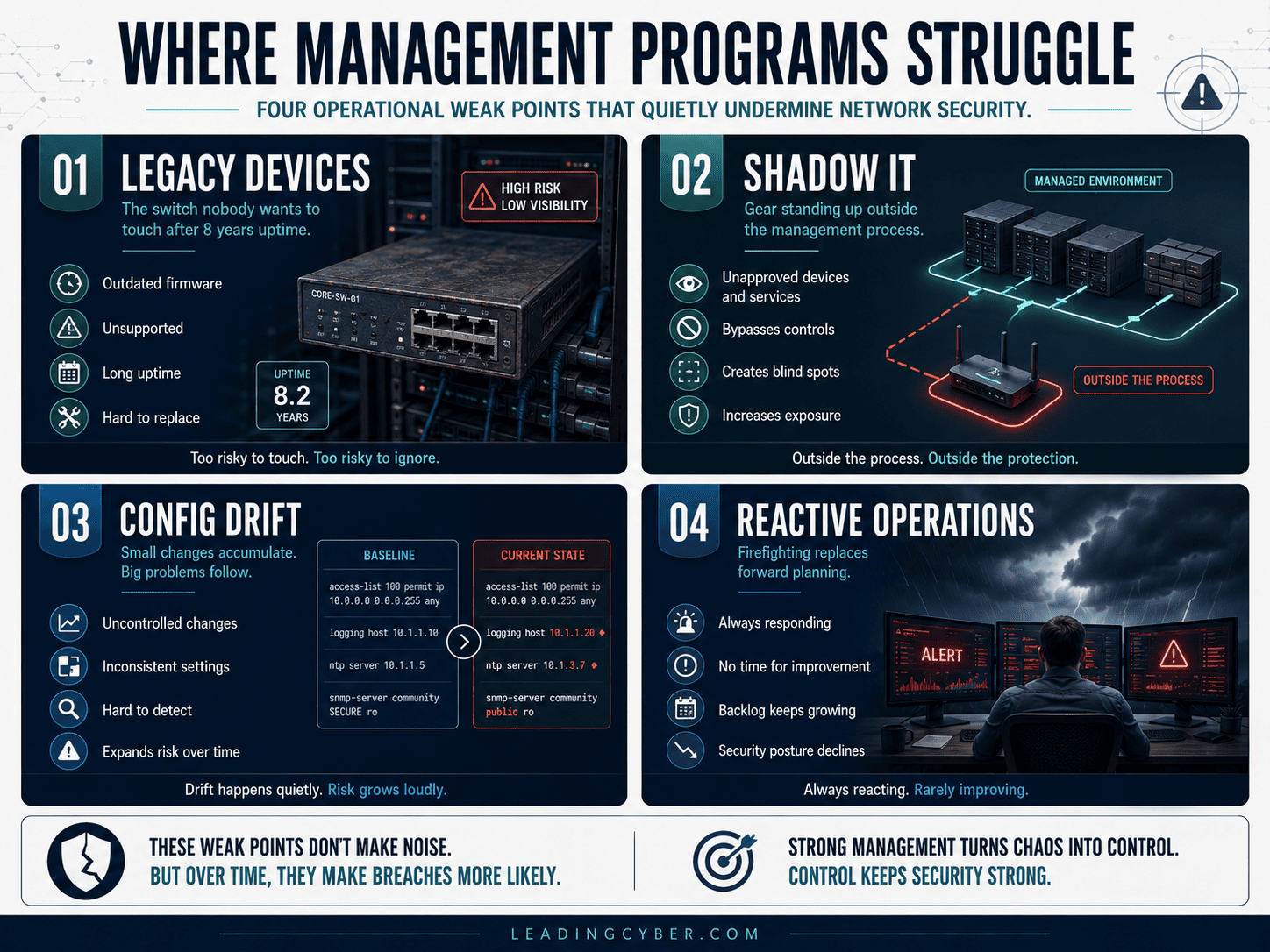
- Legacy devices nobody wants to touch. The switch that’s run for eight years without a reboot because everyone’s afraid of what happens if it goes down — a genuine management problem with no clean technical fix, just the slow work of finally scheduling the change window.
- Shadow IT creeping in. Departments standing up their own network gear or cloud connections outside the management process, quietly expanding what needs to be managed without anyone officially deciding it should.
- Remote work expanding the perimeter. Home networks, personal devices, and a dozen new remote-access paths all now fall inside network security management’s scope, whether the program was built to handle that or not.
- Alert fatigue turning into management fatigue. When monitoring generates more findings than the management team can act on, a backlog accumulates quietly — and a backlog that keeps growing is functionally the same as having no management program at all.
For Leaders: In-House, Outsourced, or Hybrid?
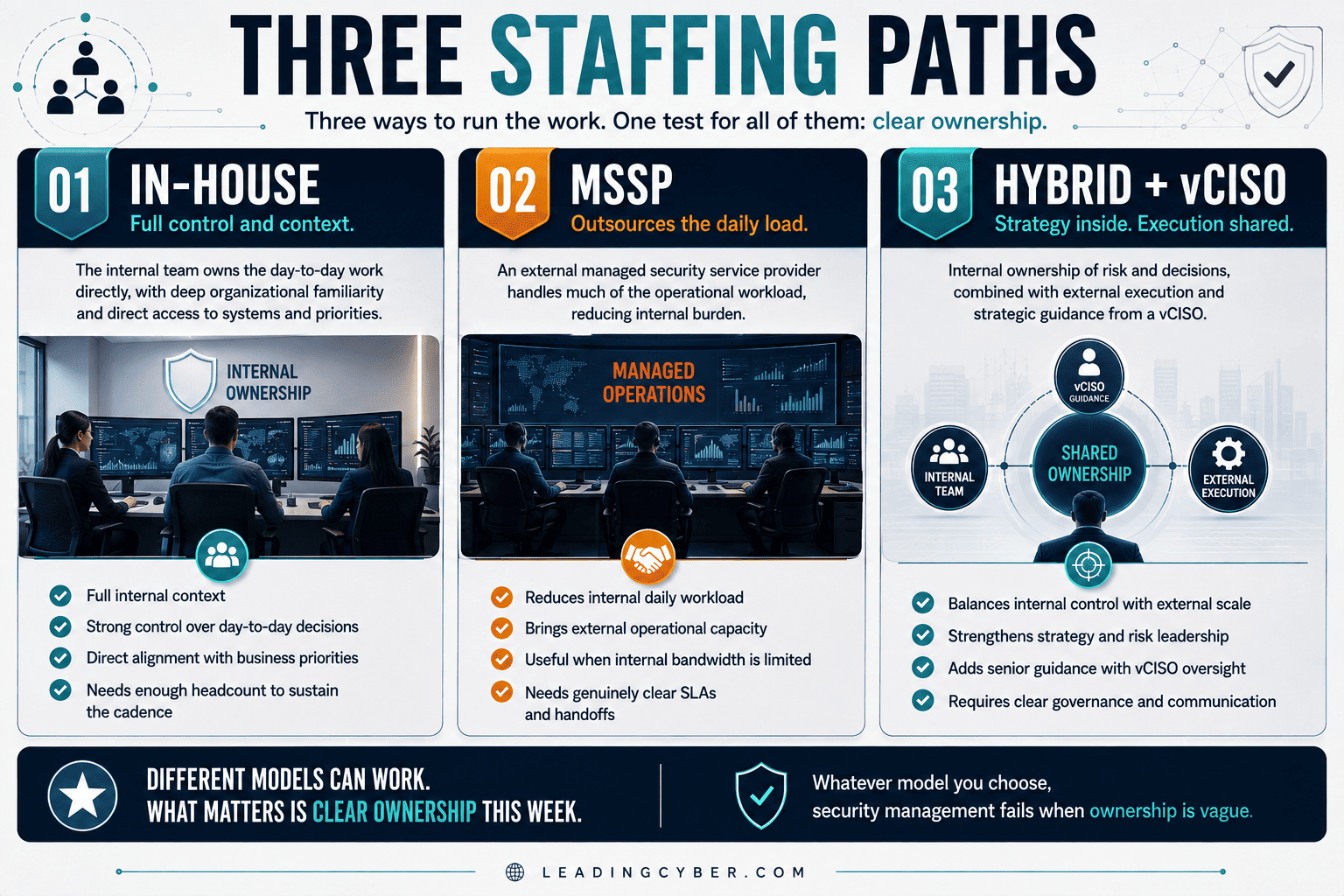
The staffing question every growing organization eventually faces. Three realistic paths:
- In-house team — full control and context, but requires enough headcount to cover the ongoing cadence without burning out one overloaded person. Right for organizations with enough network complexity to justify dedicated staff.
- Managed security service provider (MSSP) — outsources the day-to-day operational load, valuable for smaller teams, but requires genuinely clear service-level agreements or the “ongoing” part quietly slips back into “occasional.”
- Hybrid, with a vCISO providing direction — an increasingly common model where a vCISO sets strategy and priorities while internal staff or an MSSP execute the daily management work. This mirrors the same people, process, and technology logic that runs through everything else in security: the technology needs a person driving it, on a defined process, or it drifts.
Whichever path fits, the same test applies: can you name, right now, who owns network security management this week? If the honest answer is “nobody specifically,” that’s the actual finding — before any tool or assessment tells you anything else.
Key Takeaways
- Network security management is the ongoing operational job — assessment finds gaps, monitoring watches for exploitation, management is what actually closes and maintains them
- Core components: access management, device lifecycle, segmentation upkeep, policy enforcement, patching, and incident response coordination
- Programs fail most often from lack of a maintenance calendar and explicit ownership, not lack of technical skill
- Legacy devices, shadow IT, remote work expansion, and alert backlogs are the recurring operational challenges
- Whether in-house, outsourced, or hybrid, someone has to be nameable as the owner this week — that’s the real test
Frequently Asked Questions
What is network security management?
Network security management is the ongoing operational discipline of maintaining, configuring, and governing an organization’s network security controls — including access, devices, segmentation, and policy enforcement — as a continuous responsibility rather than a periodic project. It’s the daily and weekly work of implementing what assessments find and acting on what monitoring reveals.
What is the difference between network security management, assessment, and monitoring?
An assessment is a point-in-time evaluation answering where the network is weak today. Monitoring is continuous watching, answering whether something suspicious is happening right now. Management is the ongoing operational job of actually running the network’s security — access, devices, segmentation, and policy — and is what turns assessment findings and monitoring alerts into real, lasting fixes.
What does network security management include?
Six core components: ongoing access management (granting, reviewing, revoking), device lifecycle management (firmware, configuration drift), segmentation upkeep as the network grows, enforcement of the organization’s information security policy, patch and configuration management, and coordination with incident response so the operational muscle memory is ready when something goes wrong.
Should network security management be in-house or outsourced?
It depends on network complexity and available headcount. In-house teams offer full control and context but need enough staff to sustain the ongoing cadence without burnout. Managed security service providers (MSSPs) suit smaller teams but require clear service-level agreements. A hybrid model, often with a vCISO setting strategy while internal staff or an MSSP execute daily work, is increasingly common for mid-size organizations.
Why do network security management programs fail?
Most often from lack of a maintenance calendar and explicit ownership rather than lack of technical skill. Without a defined cadence for patching, access reviews, and segmentation checks, good intentions quietly evaporate. Without a named owner, “the IT team” collectively owning it functionally means nobody does, and monitoring alerts pile into a backlog nobody has the bandwidth to resolve.
How does network security management relate to incident response?
Network security management owns the operational muscle memory that makes incident response actually work — knowing the network’s current segmentation, access structure, and device inventory in real time, rather than discovering during a crisis that the documentation is stale. A well-managed network turns incident response from an improvised scramble into the execution of a plan built on accurate, current information.