
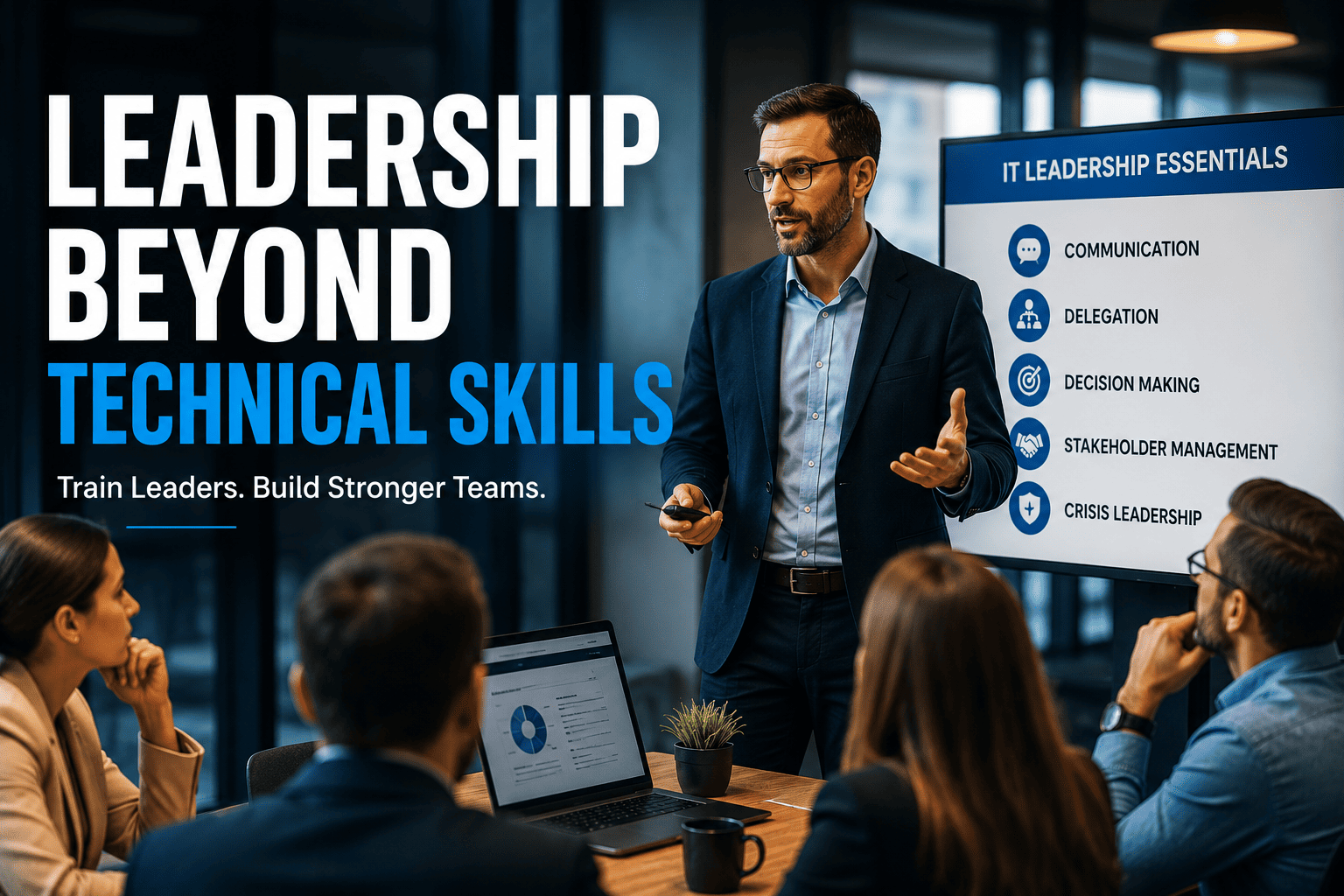
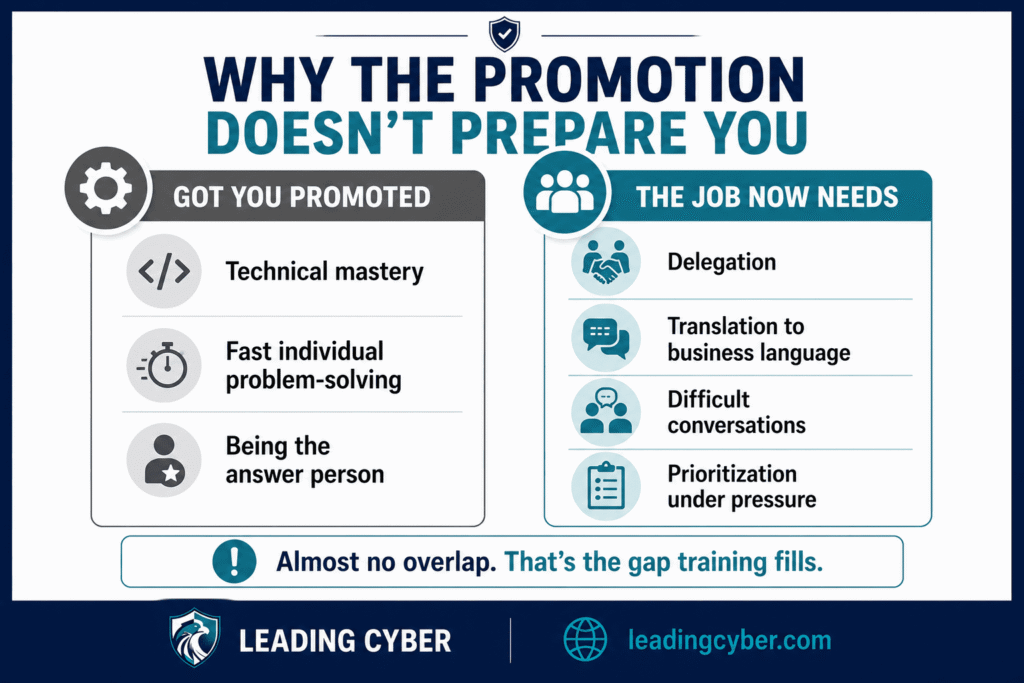
Every organization I’ve watched promote a strong engineer into a leadership role makes the same silent bet: that leadership will just happen, the way it happened for whoever’s in charge now. It usually doesn’t. IT leadership training exists precisely because the skills that get someone promoted — technical mastery, fast problem-solving — are almost never the skills the new role actually requires.
This guide covers what IT leadership training should actually contain, the formats that work versus the ones that waste a Tuesday afternoon, how to build a program without an outside vendor, and how to know if it’s working.
What Is IT Leadership Training?
IT leadership training is structured development that helps technical professionals build the skills leadership requires beyond technical expertise — communication, delegation, stakeholder management, and decision-making under uncertainty — typically for people transitioning from individual contributor to manager, or already managing and never formally taught how.
The gap it fills is well documented and painfully familiar: someone becomes a manager because they were the best engineer in the room, then discovers the job has almost nothing to do with engineering. I wrote about my own version of this in what I got wrong leading my first IT team — training is the thing that could have shortened that learning curve by years.
What Good IT Leadership Training Actually Covers
Skip the generic “soft skills” workshop. Effective programs for technical leaders focus on a specific set of muscles:
- Delegation and letting go of the keyboard — the hardest transition for most technical leaders, and the one training can accelerate fastest
- Translating technical risk into business language — explaining why a patch window matters to someone who’s never heard of a CVE
- Difficult conversations — performance issues, scope pushback, telling a stakeholder “no” without becoming the department nobody wants to work with
- Prioritization under conflicting pressure — security wants patching, product wants features, and everyone wants it yesterday
- Managing up and across — the leadership work that happens outside your own reporting line, which is where most new leaders get blindsided
- Crisis communication — because the first real leadership test for most IT managers is an incident, not a performance review
Notice what’s missing from that list: more technical certifications. Technical depth is assumed at this level. Training that just adds another cert to someone already drowning in delegation problems is solving the wrong gap.
Training Formats: What Works and What Doesn’t
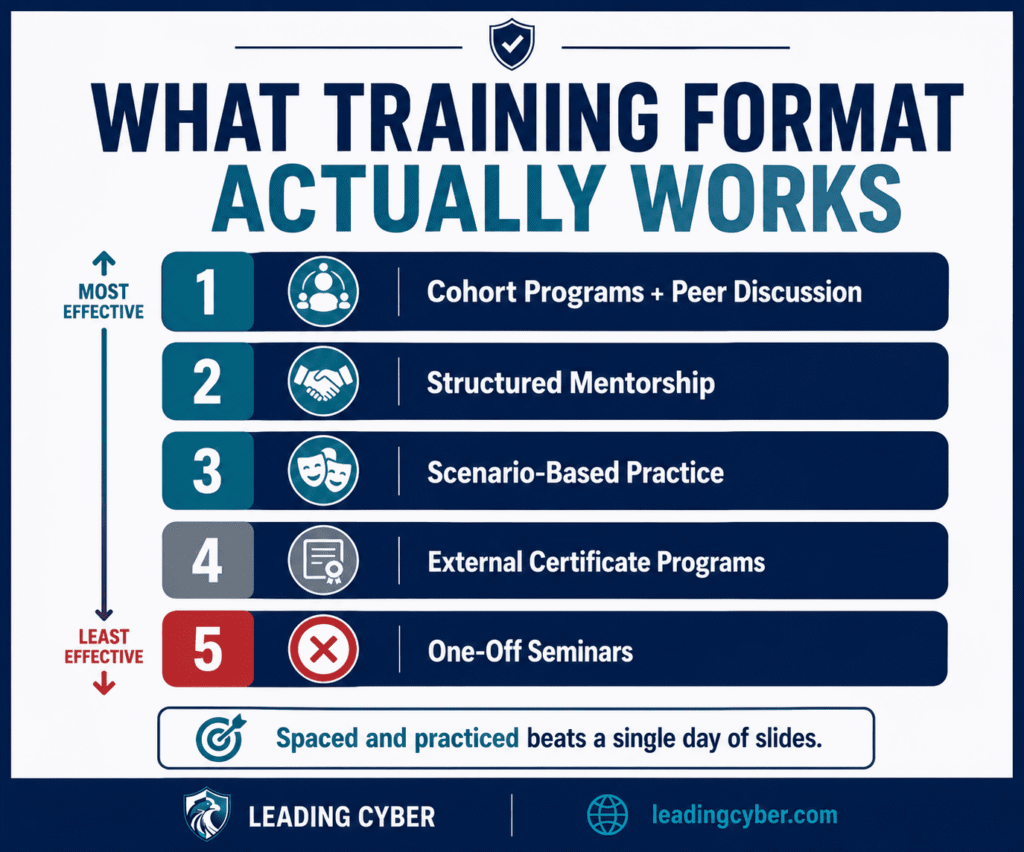
- Cohort-based programs — a group of peers moving through material together, ideally with people outside their own team. The peer discussion is often worth more than the curriculum; hearing “you too?” from someone in a different department is its own kind of training.
- Mentorship and shadowing — pairing a new leader with someone a level or two up, with actual structured time, not a vague “reach out if you need anything.” Unstructured mentorship rarely survives a busy quarter.
- Scenario-based workshops — practicing a real, hard conversation before having it for real. Cheap to run, disproportionately effective.
- External certificate programs — useful for structure and credibility, weak on their own without internal reinforcement. A certificate says someone attended; it doesn’t mean the org changed how it develops leaders.
- One-off seminars — the format that quietly wastes the most training budget in the industry. A single day rarely survives contact with the following Monday’s inbox.
The pattern across what actually works: spaced over time, practiced on real scenarios, reinforced by a real person checking in — not a single injection of content.
Building an IT Leadership Training Program Without a Vendor
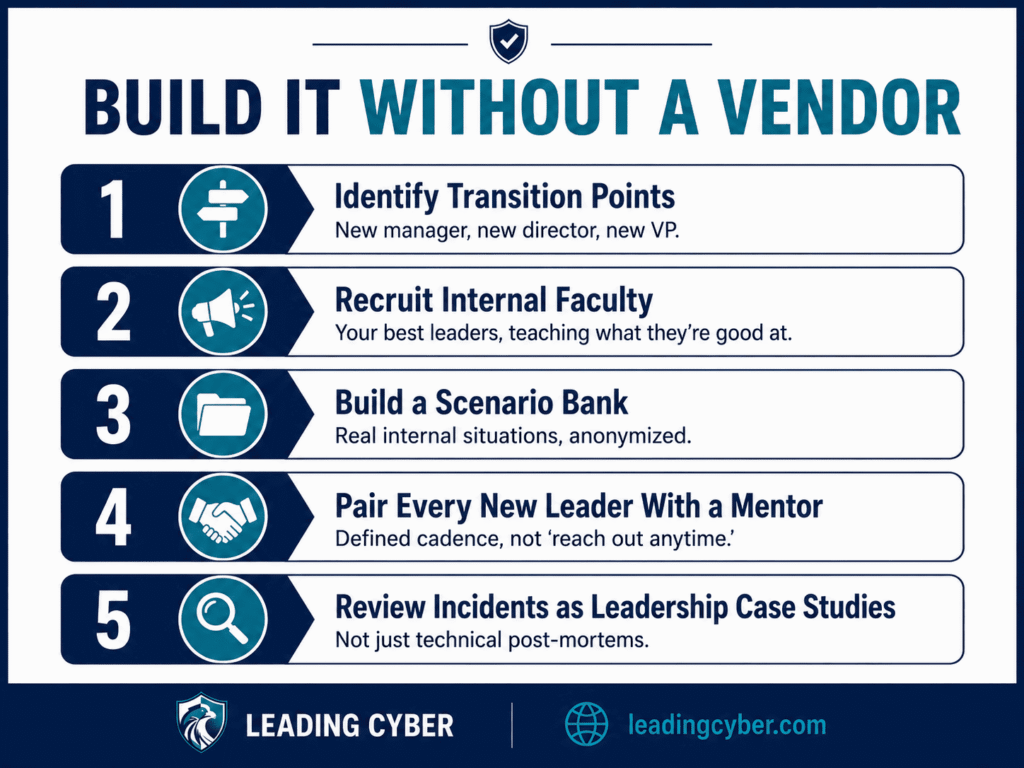
You don’t need to buy a program to start one. A workable internal version:
- Identify the transition points — new manager, new director, new VP. Each transition has different failure modes and needs different content.
- Recruit your best leaders as faculty. The person who’s actually good at delegation teaching a session on delegation beats a slide deck every time, and it costs nothing but their time.
- Build a scenario bank. Collect the real hard conversations your organization has actually faced — anonymized — and use them as practice material. This is more valuable than any purchased case study, because it’s your organization’s actual terrain.
- Pair every new leader with a mentor, with a defined cadence (biweekly, minimum) and a light structure — a handful of standing questions beats an open-ended “how’s it going?”
- Review incidents as leadership case studies, not just technical post-mortems. Most incidents contain a leadership lesson (communication, decision authority, escalation) buried inside the technical one.
This is also exactly the gap a good vCISO often fills for smaller organizations that can’t build an internal faculty yet — borrowed leadership experience, applied directly to real decisions rather than delivered as a workshop.
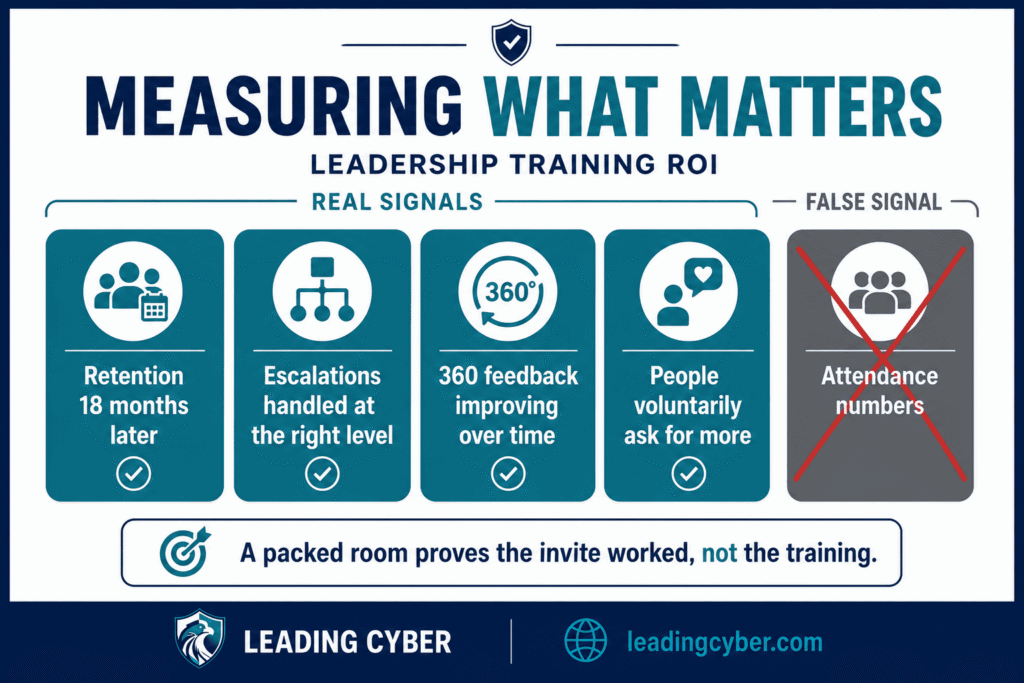
How to Know If It’s Working
Training that doesn’t change behavior is theater with a certificate at the end. A few honest signals worth tracking:
- Retention of new leaders — are people who get promoted still there and thriving eighteen months later, or quietly burning out?
- Escalation patterns — are leaders solving problems at the right level, or is everything still flowing up to the person above them?
- 360 feedback trends — not a single score, but whether it’s moving over successive cycles
- Whether people ask for the training — voluntary sign-up for advanced sessions is the strongest signal that the first round actually helped
What doesn’t count as a signal: attendance. A packed room proves the invite worked, not the training.
Key Takeaways
- IT leadership training addresses the skills gap between technical promotion and leadership reality — delegation, translation, difficult conversations, prioritization
- Formats that spread over time and get practiced on real scenarios outperform one-off seminars by a wide margin
- Internal programs — peer faculty, a real scenario bank, structured mentorship — cost less than vendors and often teach more relevant lessons
- Measure it by retention, escalation patterns, and whether people voluntarily come back for more — not by attendance
- A vCISO can substitute borrowed leadership experience for organizations too small to build internal faculty yet
Frequently Asked Questions
What is IT leadership training?
IT leadership training is structured development that helps technical professionals build skills beyond technical expertise — communication, delegation, stakeholder management, prioritization, and decision-making under uncertainty. It’s designed for people moving from individual contributor to manager, or managers who were promoted for technical skill and never formally taught to lead.
Why is IT leadership training important?
Because the skills that earn a technical promotion — deep expertise, fast individual problem-solving — are rarely the skills the leadership role actually needs. Without training, new leaders default to the habits that got them promoted, which often means micromanaging technical decisions instead of building a team that can make them. Training shortens a learning curve that otherwise takes years of costly trial and error.
What should IT leadership training include?
Delegation, translating technical risk into business language, having difficult conversations, prioritizing under conflicting pressure, managing relationships outside the direct reporting line, and crisis communication. It should generally assume technical competence is already present and focus squarely on the people and judgment skills the role adds on top of it.
How do you build an IT leadership training program internally?
Identify the key transition points (new manager, new director), recruit your organization’s best leaders to teach what they’re actually good at, build a scenario bank from real internal situations, pair every new leader with a mentor on a defined cadence, and review incidents for leadership lessons alongside technical ones. This costs far less than external vendors and often teaches more directly relevant lessons.
How do you measure the success of leadership training?
Track whether newly promoted leaders are still there and thriving eighteen months later, whether escalations are being handled at the appropriate level rather than all flowing upward, whether 360-degree feedback trends improve over successive cycles, and whether people voluntarily seek out further training. Attendance numbers measure interest in the invite, not whether behavior actually changed.
What is the difference between IT leadership training and technical certifications?
Technical certifications validate specific technical knowledge — a firewall configuration, a cloud platform, a security framework. IT leadership training addresses an entirely different skill set: how to delegate, communicate, prioritize, and lead people rather than systems. Both matter, but adding another technical certification to someone struggling with delegation solves the wrong problem.