I’ve sat in enough compliance meetings to know this exact moment: someone asks “do we have a data security policy?” and three different people produce three different documents, each partially right and none of them the actual answer. Between the information security policy, the data protection strategy, and the data security policy itself, the naming genuinely confuses people — including plenty of IT teams who should know better.
So let’s fix that here. This guide defines what a data security policy actually is, how it’s different from its two closest relatives, what it needs to cover, and a template outline you can adapt today.
What Is a Data Security Policy?
A data security policy is a document that defines the specific technical controls and rules for protecting data from unauthorized access, loss, or corruption — covering encryption, access control, storage, transmission, and disposal of data across its lifecycle.
Notice how narrow that definition is compared to what people usually expect. A data security policy isn’t about strategy, and it isn’t about the whole organization’s security posture. It’s specifically about the technical rules that keep data safe once you’ve decided what data matters and why — which is exactly where the confusion with its two relatives comes from.
Data Security Policy vs. Information Security Policy vs. Data Protection Strategy
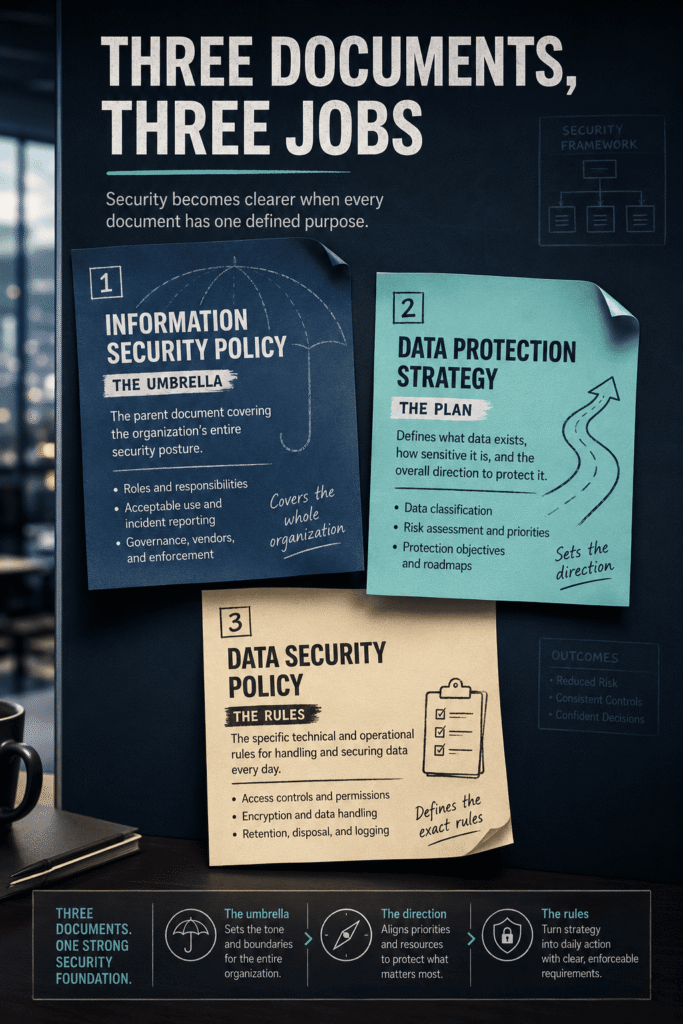
Three documents, three different jobs, and yes, the names really do overlap enough to cause genuine confusion:
- Information security policy — the parent document. It covers the whole organization’s security posture: roles, acceptable use, incident reporting, vendor security, enforcement. Data is one section inside it, not the whole document.
- Data protection strategy — the plan. It answers what data exists, how sensitive it is, and the overall approach to protecting it across its lifecycle, including regulatory considerations like GDPR or HIPAA.
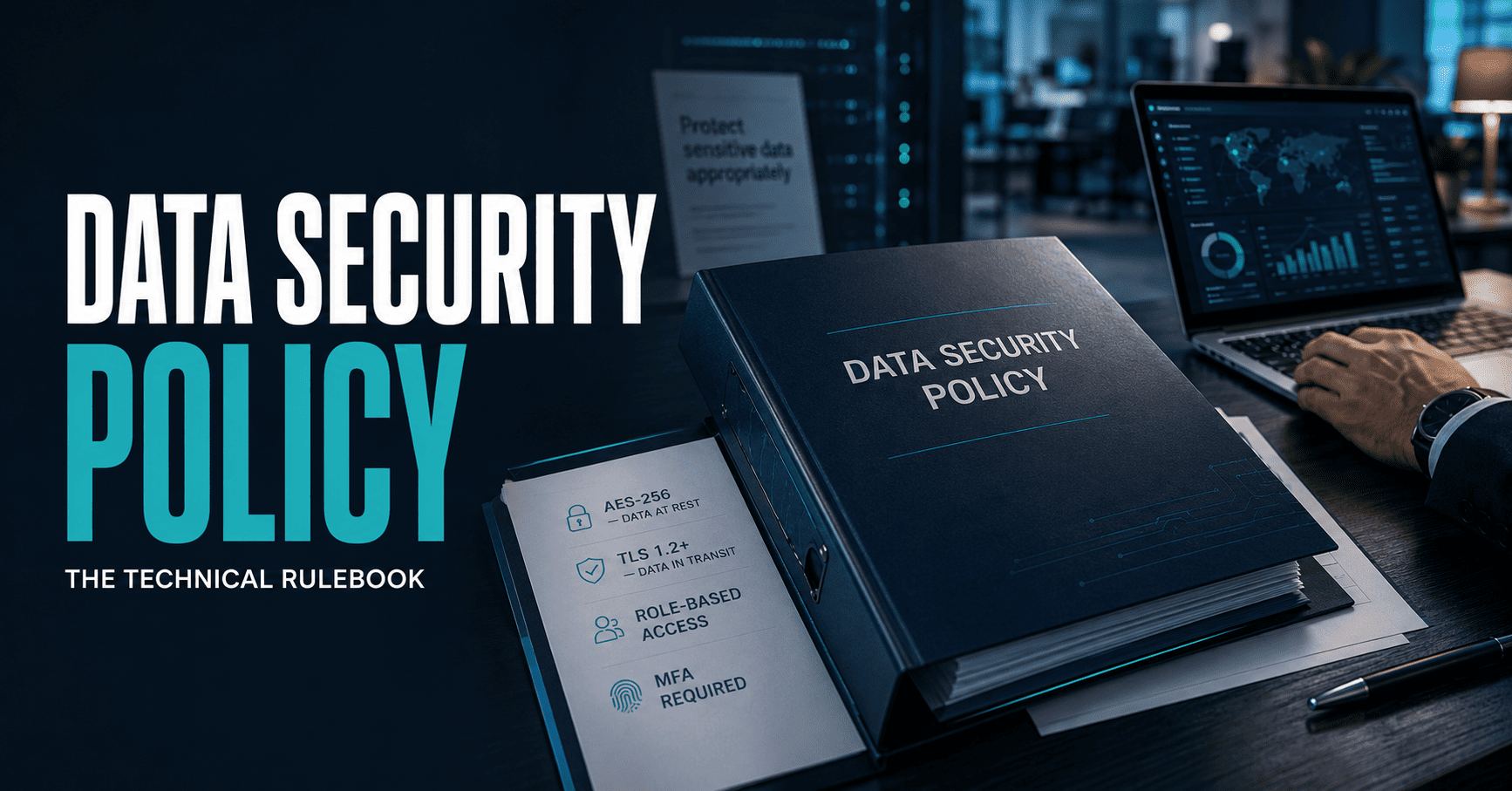
- Data security policy — the rulebook. It gets specific and technical: exact encryption standards, exact access control mechanics, exact rules for moving data between systems. Where the strategy says “protect confidential data appropriately,” the data security policy says “confidential data at rest must use AES-256; confidential data in transit must use TLS 1.2 or higher.”
Here’s the mental shortcut I use: strategy sets direction, policy sets rules, and the information security policy is the umbrella both sit under. If your data protection strategy is the “why” and “what,” your data security policy is the “exactly how.”
What a Data Security Policy Should Include
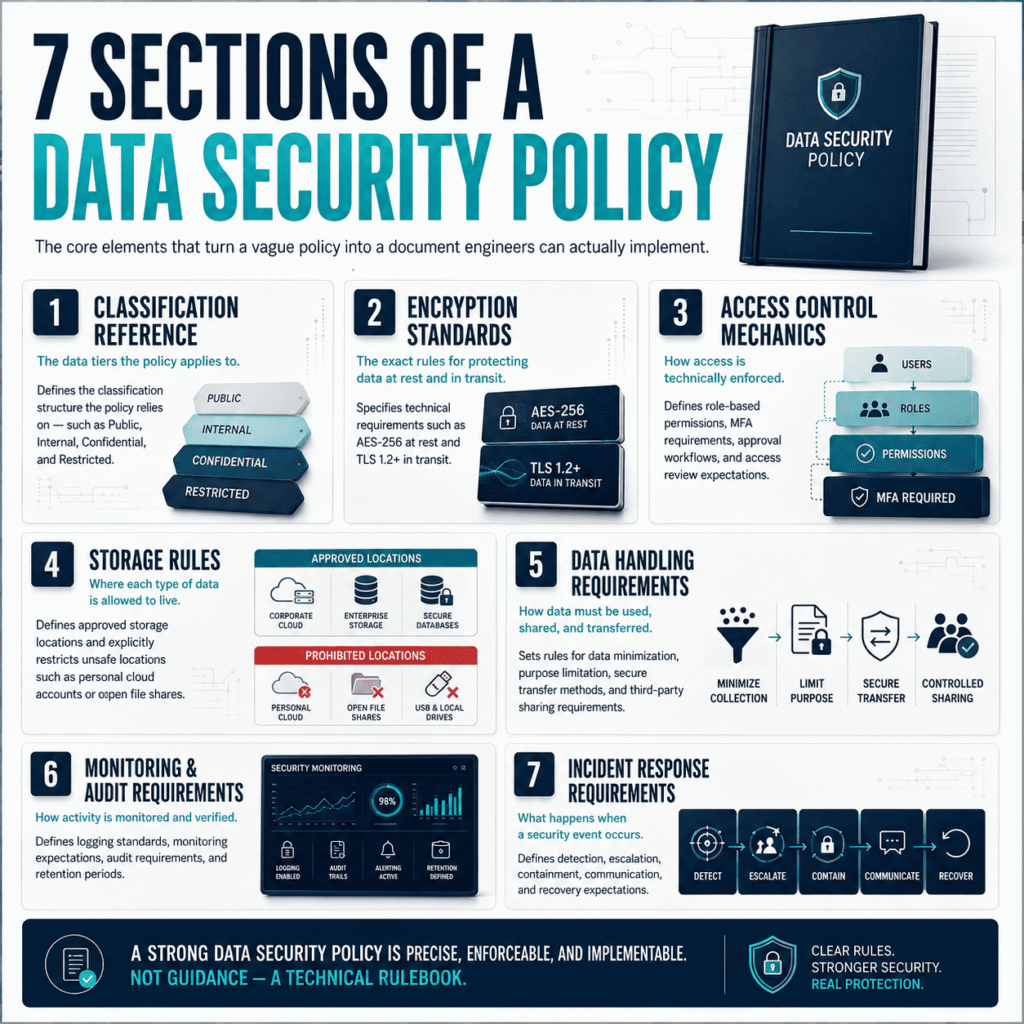
Seven sections cover what auditors expect and what actually protects data in practice:
- Data classification reference — the tiers (public, internal, confidential, restricted) this policy applies its rules against. This section usually just points back to the classification scheme defined in the data protection strategy rather than redefining it.
- Encryption standards — specific algorithms and minimums for data at rest and in transit. No vague language; auditors and engineers both need exact numbers, like “AES-256 at rest” and “TLS 1.2 minimum in transit.”
- Access control mechanics — how access is technically enforced: role-based permissions, multi-factor authentication requirements, and the specific systems that hold each data tier.
- Storage rules — where each classification is allowed to live. Restricted data typically can’t sit in a general file share or an employee’s personal cloud account, and this section says so explicitly.
- Transmission rules — how data may move between systems, vendors, and people. Email attachments carrying restricted data, for instance, are usually banned outright here rather than merely discouraged.
- Retention and disposal — how long each tier is kept and the technical method of destruction (secure deletion versus simple deletion actually matter, and this is where that distinction gets written down).
- Monitoring and audit requirements — what gets logged, for how long, and who reviews it. This ties directly into whether you’d actually notice data leaving where it shouldn’t.
Free Data Security Policy Template (Outline)
Copy this skeleton and fill in your organization’s actual standards. Kept tight, this runs 3–5 pages — shorter than its parent information security policy, because it only covers the technical specifics.
[ORGANIZATION NAME] — Data Security Policy
Version: [X.X] | Owner: [Role, e.g., CISO / IT Director] | Parent document: Information Security Policy | Review date: [Annual]
1. Purpose & Scope
This policy defines the technical controls required to protect [Organization]’s data across its lifecycle, in support of the Information Security Policy and Data Protection Strategy. Applies to all data classified under [Data Classification Standard].
2. Classification Reference
Data is classified as Public, Internal, Confidential, or Restricted per [Data Classification Standard]. This policy defines the technical controls required for each tier below.
3. Encryption Requirements
Confidential and Restricted data must be encrypted at rest using [AES-256 or equivalent] and in transit using [TLS 1.2 or higher]. [Internal] data should be encrypted where feasible. Encryption keys are managed per [Key Management Standard].
4. Access Control
Access to Confidential and Restricted data requires [role-based approval] and [multi-factor authentication]. Access is reviewed [quarterly] and revoked upon role change or departure, per the access control section of the Information Security Policy.
5. Storage Rules
Restricted data may only be stored in [approved systems, e.g., the production database and its encrypted backups] — never in general file shares, email, or personal cloud storage. Confidential data follows [storage rules per tier].
6. Transmission Rules
Restricted data must not be sent via unencrypted email or unapproved file-sharing tools. Approved transmission methods: [secure file transfer, encrypted email, approved API]. Exceptions require [written approval].
7. Retention & Disposal
Each classification tier is retained per [Data Protection Strategy retention schedule]. Disposal of Confidential and Restricted data must use [secure deletion / cryptographic erasure], not standard deletion.
8. Monitoring & Audit
Access to Restricted data is logged and retained for [12 months]. Logs are reviewed [monthly] for anomalous access patterns, per the monitoring requirements defined in the organization’s broader security program.
9. Enforcement & Review
Violations are handled per the Information Security Policy’s enforcement section. This policy is reviewed [annually] and whenever encryption standards, storage systems, or regulatory requirements change.
Notice this template leans on its parent documents constantly — “per the Information Security Policy,” “per the Data Protection Strategy.” That’s intentional. A data security policy that tries to stand alone either duplicates its parents badly or contradicts them eventually.
Data Security Policy Examples: What Separates Good From Decorative
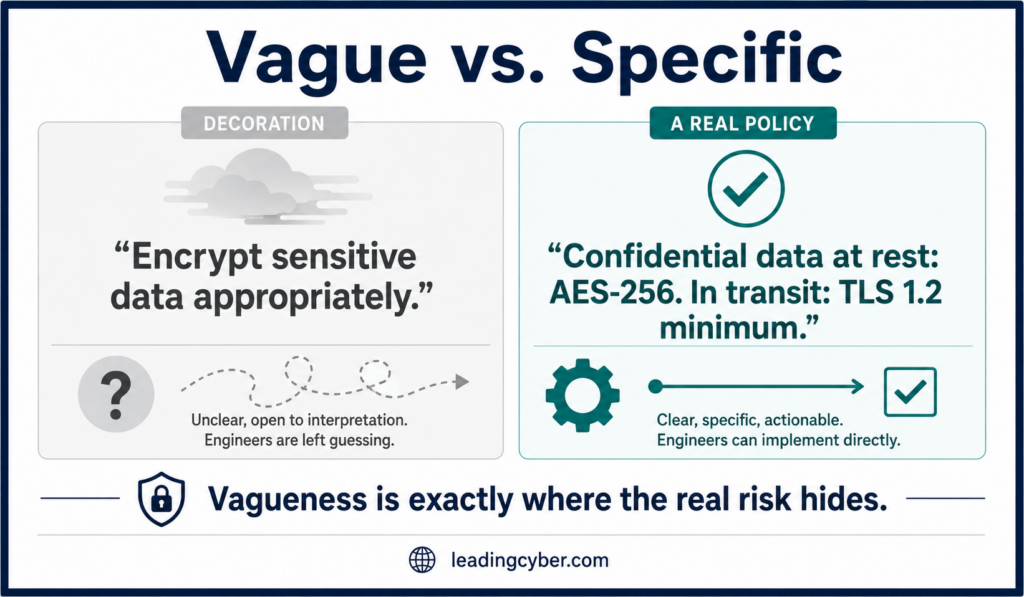
Search for data security policy examples online and you’ll find plenty — quality varies enormously. The good ones share one trait above all others: they’re specific enough that an engineer could implement them without a follow-up meeting. “Encrypt sensitive data” is decoration. “Confidential data at rest: AES-256; in transit: TLS 1.2 minimum” is a policy. If a template you’re borrowing from stays vague at the technical level, tighten it before adopting it — vagueness here is exactly where the real risk hides.
For Leaders: Why This Document Gets Skipped
In my experience, the data security policy is the document most likely to go missing entirely, and not because anyone decided against it. It falls through the gap between the information security policy (which feels complete on its own) and the data protection strategy (which feels sufficiently technical already). Neither actually is. Assign explicit ownership of this document to someone technical — usually IT or a vCISO — because “the security team” owning it, without a name attached, is exactly how it stays unwritten for years.
Key Takeaways
- A data security policy defines the specific technical controls for protecting data — encryption, access, storage, transmission, retention, monitoring
- It’s the narrowest of three related documents: strategy sets direction, this policy sets exact rules, the information security policy is the umbrella over both
- Good policies use specific numbers and standards, not vague language like “encrypt sensitive data appropriately”
- Every tier’s storage, transmission, and disposal rules should be explicit enough to implement without a follow-up conversation
- This document falls through organizational cracks more than any other — assign it a named owner
Frequently Asked Questions
What is a data security policy?
A data security policy is a document that defines the specific technical controls for protecting data — encryption standards, access control mechanics, storage and transmission rules, and retention and disposal procedures. It’s narrower and more technical than an information security policy or a data protection strategy, focusing specifically on the exact rules that keep data safe throughout its lifecycle.
What is the difference between a data security policy and an information security policy?
An information security policy is the parent document covering an organization’s entire security posture — roles, acceptable use, incident reporting, vendor security, and enforcement, with data as one section among many. A data security policy is narrower and more technical, focused specifically on the exact controls protecting data: encryption standards, access mechanics, storage and transmission rules. Most organizations need both, with the data security policy nested under the broader one.
What is the difference between a data security policy and a data protection strategy?
A data protection strategy is the overall plan: what data exists, how sensitive it is, and the general approach to protecting it across its lifecycle, including regulatory considerations. A data security policy is the technical rulebook underneath that strategy, specifying exact requirements like encryption algorithms and access control mechanics. The strategy sets direction; the policy sets the precise rules that implement it.
What should a data security policy include?
Seven core elements: a reference to the organization’s data classification tiers, specific encryption standards for data at rest and in transit, access control mechanics, storage rules per classification tier, transmission rules for moving data between systems and people, retention and disposal procedures, and monitoring and audit requirements. Each should be specific enough to implement without a follow-up conversation.
How is a data security policy different from a data classification policy?
A data classification policy defines the categories data falls into (public, internal, confidential, restricted) and the criteria for assigning them. A data security policy takes those categories as a given and defines the technical controls applied to each one — encryption, access, storage, and transmission rules. Classification answers “what tier is this data?”; the security policy answers “what happens to data in that tier?”
Who should own the data security policy?
A named technical role — typically IT leadership, a CISO, or a vCISO for smaller organizations — should own drafting, maintaining, and enforcing the data security policy. This document commonly falls through organizational cracks because it sits between broader documents that each feel sufficient on their own, so explicit, named ownership matters more here than almost any other security document.