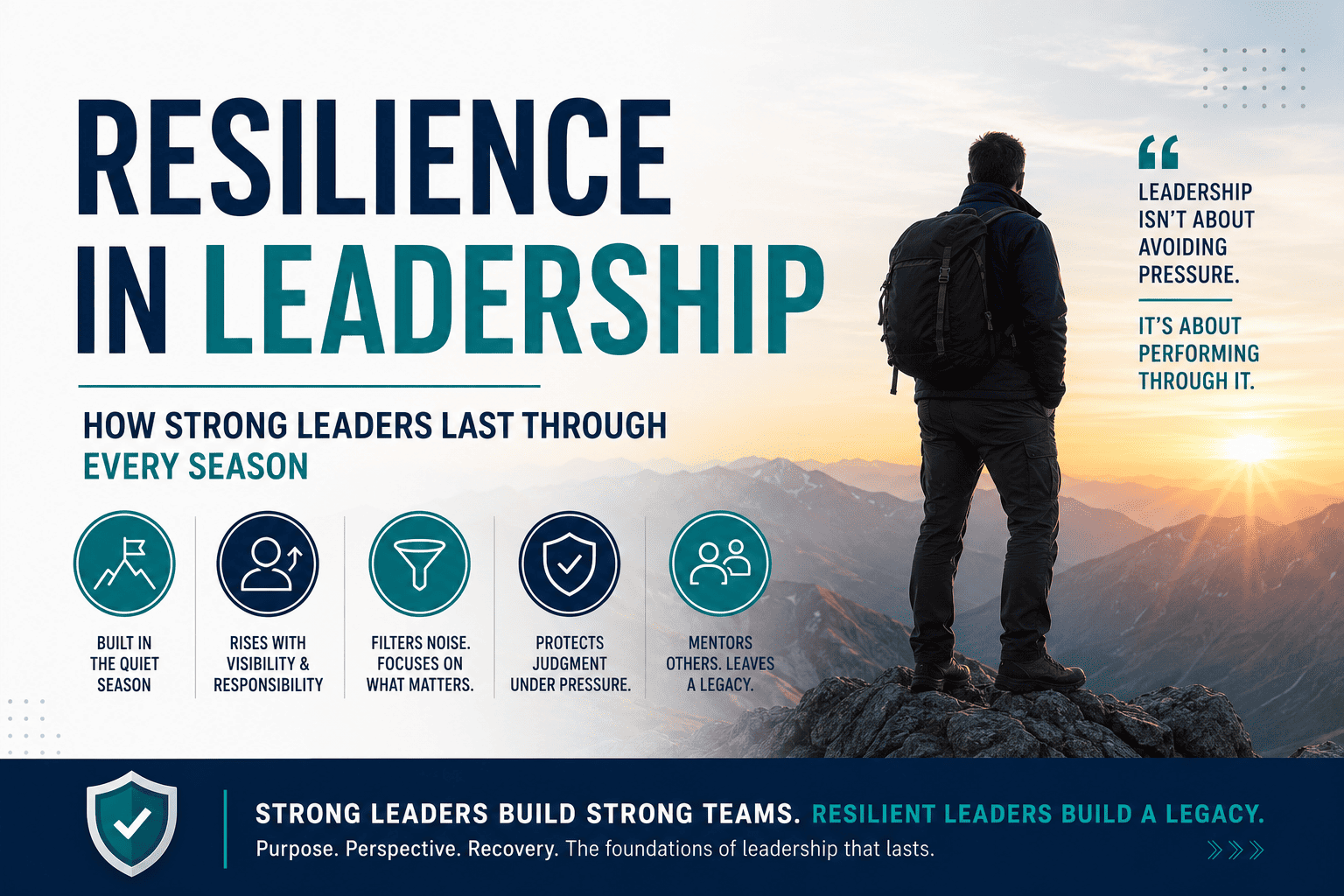
Every leader’s career moves through seasons — quiet ones where the work is invisible, and loud ones where every decision is watched. What separates leaders who burn out from leaders who last isn’t talent or timing. Furthermore, it’s resilience in leadership: the capacity to keep making sound decisions as visibility, pressure, and responsibility all grow at once.
For IT and security leaders especially, this matters. Moreover, the jump from “technical expert” to “the person accountable when something breaks” happens fast, and it rarely comes with a manual. Therefore, understanding why resilience is important in leadership — and how it actually develops, season by season — makes that transition survivable, and eventually, sustainable.

What Is Resilience in Leadership?
At its core, resilience in leadership is the ability to maintain sound judgment, composure, and decision-making quality as pressure, visibility, and responsibility increase. Furthermore, it is not a personality trait some leaders are born with and others aren’t — it’s a set of habits built deliberately, usually long before anyone is watching.
Why Is Resilience Important in Leadership?
Leadership roles inherently involve rising stakes — more scrutiny, more consequences, more feedback, often all at once. Without resilience, leaders either burn out under the pressure or become reactive to noise instead of steady in their decisions. Moreover, in security and IT leadership specifically, this shows up constantly: every outage, every audit finding, every board question becomes a referendum on judgment. Therefore, leadership resilience isn’t a soft skill on the side — it’s the mechanism that keeps decision quality intact when the stakes are highest.
The Quiet Season: Where Resilient Leadership Actually Starts
Nobody becomes a resilient leader in the spotlight. Instead, it happens earlier, in the season where the work is unglamorous and mostly unseen — late nights fixing what nobody asked you to fix, building competence nobody is grading yet. There’s no applause here, just reps: practice, mistakes, adjustments, more practice.
The absence of an audience is actually the advantage — you get to fail cheaply, before the stakes are public. Furthermore, this is also where a genuine success mindset gets built, not inherited. It’s less about believing you’ll succeed and more about trusting that the invisible work compounds. Research on deliberate practice backs this up: mastery consistently comes from private, repeated effort long before public recognition shows up. Therefore, success is a mindset you practice in the dark, long before anyone hands you a title for it.
If you’re early in this season and it feels slow, that’s not a warning sign — it’s the mechanism. For more on how persistence shapes long-term outcomes, see Life Lessons About Resilience.
The Rise: Why Resilient Leadership Matters Once You’re Visible
At some point the quiet work starts producing visible results — a promotion, a bigger team, a seat in the room where decisions get made. Therefore, this is where resilience in leadership stops being theoretical and starts getting tested weekly.
Visibility changes the math. Feedback gets louder, and opportunities multiply — but so does scrutiny. Furthermore, for a new IT leader, this is often the exact moment technical skill stops being the main job requirement, and judgment, communication, and composure under pressure take over. Moreover, that transition trips up more new leaders than any technical gap ever does — a pattern covered in more detail in IT Leadership Mistakes I Made Leading My First Team, where the biggest early failures weren’t technical at all. They were about identity and expectations shifting faster than the leader could adjust to them.
This is also where identity starts to wobble. Instead of “the person who does the work,” you become “the person responsible for the work” — a bigger psychological shift than most leaders expect. For a deeper look at how perspective shapes this transition, see Shifting Perspective on Life.
Leadership Resilience Under Constant Feedback
Visibility brings noise — and in security and IT leadership, that noise can be relentless. Every outage, every audit finding, every board question becomes a referendum on your judgment. Furthermore, leadership resilience at this stage is largely a filtering skill.
Not all feedback deserves equal weight. Constructive criticism should shape your decisions; noise rooted in politics, fear, or envy shouldn’t. Moreover, leaders who can’t tell the difference either become defensive and stop improving, or become reactive and start chasing every complaint instead of running the organization. Therefore, the fix isn’t ignoring feedback — it’s anchoring to a clear, stable purpose so external opinion doesn’t become your only compass. Behavioral research on motivation consistently shows that a strong internal compass is what keeps people steady in high-visibility, high-pressure roles.
Resilience and Leadership: The Ethical Weight of a Bigger Platform
As influence grows, so does responsibility. This is a part of resilience and leadership that gets skipped in most “success” content, but it’s arguably the most important part.
A larger platform means your decisions carry consequences for more people — your team, your organization, sometimes your customers’ security posture. Therefore, transparency, humility, and a willingness to say “I don’t know yet” become leadership requirements, not optional soft skills. Furthermore, the connection between resilience and leadership also shows up in how established leaders treat people earlier in their own quiet season. Leaders with real staying power tend to open doors for others rather than guard the ladder behind them — sharing what they’ve learned, mentoring, and building teams instead of just managing them. That dynamic is explored further in The Power of Community.
Protecting the Leader Behind the Title
Here’s what a lot of leadership content gets wrong: it assumes visibility removes vulnerability. However, it usually increases it. Fear of losing momentum, fear of being exposed as “not enough,” pressure to protect a reputation you’ve spent years building — all of that intensifies as the stakes rise.
Resilient leadership isn’t the absence of that pressure. Instead, it’s having deliberate practices that protect your judgment anyway. Rest is one of them, and it needs to stop being treated as optional:
“To nurture resilience, you must treat rest as a non-negotiable practice rather than a luxury.”
Reflection and recovery aren’t indulgences — therefore, they’re what keeps a leader capable of making good decisions six months from now, not just this quarter.

How to Build Resilience in Leadership: A Practical Framework
Resilience in leadership isn’t a personality trait some people are born with — it’s a set of habits. Furthermore, if you’re wondering how to achieve career success that actually lasts through the harder seasons, this is where to start:
1. Protect a Private Practice Season
Keep a project, skill, or space where you can still fail without an audience. Every leader needs somewhere low-stakes to keep learning.
2. Build a Feedback Filter
Before reacting to criticism, ask: does this come from someone with context and good intent? If not, note it and move on.
3. Anchor to Purpose, Not Applause
Write down why the work matters to you. Revisit it when external validation swings — good or bad.
4. Schedule Recovery Like You Schedule Meetings
Burned-out leaders make worse decisions under pressure, not better ones.
5. Mentor Someone Earlier in Their Season
Teaching what you’ve learned reinforces it. Furthermore, it’s one of the fastest ways to build a durable success mindset in yourself.

Lead the Next Season With Resilience
None of this guarantees career success in the way most content promises. However, leaders who build these habits tend to last through the seasons that break everyone else. Furthermore, leading resilient teams starts with leading yourself resiliently.
If you’re navigating the shift from technical expert to accountable leader, that’s exactly the season this framework was built for.
Book a discovery call with Leading Cyber to talk through what that season actually requires.
Frequently Asked Questions About Resilience in Leadership
What is resilience in leadership?
Resilience in leadership is the ability to maintain sound judgment, composure, and decision-making quality as pressure, visibility, and responsibility increase. Furthermore, it’s built through consistent habits, not innate personality traits.
Why is resilience important in leadership?
Because leadership roles inherently involve rising stakes — more scrutiny, more consequences, more feedback. Without resilience, leaders either burn out under the pressure or become reactive to noise instead of steady in their decisions.
What is resilient leadership?
Resilient leadership describes a leadership style grounded in stability under pressure: filtering feedback effectively, protecting recovery time, staying anchored to purpose, and supporting others rather than only managing them.
How do you build a success mindset as a leader?
A success mindset develops through private, repeated practice before public recognition — trusting that invisible effort compounds — combined with deliberate habits like reflection, mentorship, and purpose-driven decision-making once visibility increases.