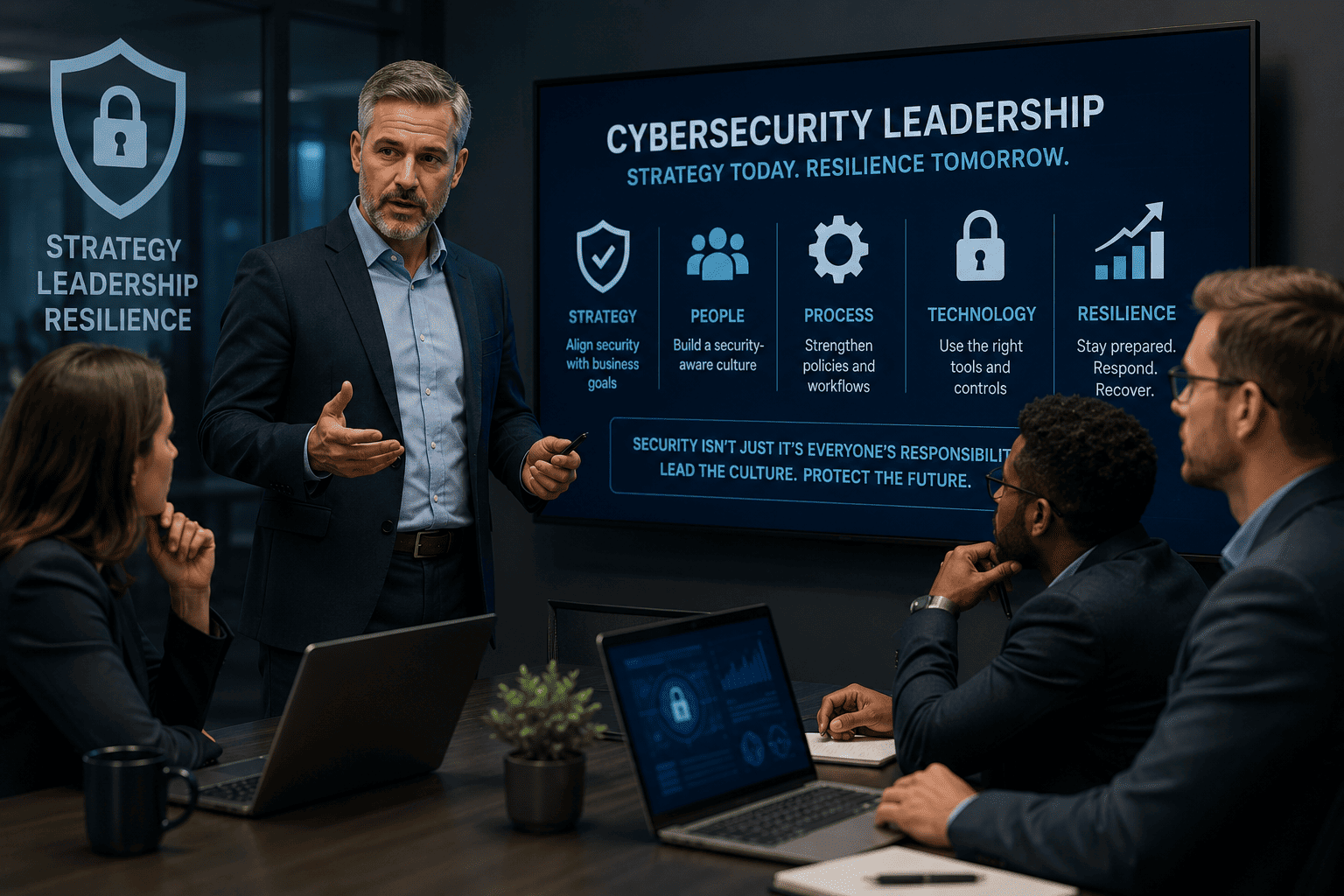
In today’s digital age, cybersecurity leadership has evolved from a technical issue to a core business priority. With cyber threats advancing faster than ever, organizations that fail to integrate cybersecurity into their strategic planning risk not only financial loss — but also their credibility and customer trust.
Modern leaders must view cybersecurity as a strategic responsibility, not an IT checkbox. Furthermore, a strong security-first culture starts at the top — with executives who understand risk, make informed decisions, and champion a culture of digital safety across the entire organization.
Why Cybersecurity Is a Leadership Issue
Cybersecurity was once seen as an IT problem. Today, it’s an organizational challenge that demands leadership awareness and accountability. Moreover, cyber risk management for leadership means understanding that cybercriminals exploit weak policies, untrained employees, and a lack of executive oversight — not just technical gaps. Phishing, ransomware, and social engineering remain highly effective, often because of human error, not technology failure.
When leaders don’t prioritize cybersecurity, they unintentionally create vulnerabilities. Therefore, effective cybersecurity leadership ensures that decision-makers understand the evolving threat landscape, allocate resources strategically, and lead with a security-first mindset. Furthermore, this kind of steadiness under pressure isn’t unique to cybersecurity — it’s the same discipline explored in Resilience in Leadership, where staying grounded as visibility and responsibility grow is what separates leaders who last from leaders who burn out.
Key Traits of Effective Cybersecurity Leaders
Strong cybersecurity leaders aren’t just technical experts — they are visionary strategists who bridge business and technology. Here are five key traits to cultivate:
✅ Strategic Thinking — Align security goals with business objectives and focus on proactive prevention, not reactive defense.
✅ Risk Awareness — Understand emerging threats and work closely with IT and compliance teams to assess vulnerabilities and mitigate risks.
✅ Decisiveness Under Pressure — Cyber incidents demand swift, informed action. A decisive leader minimizes damage and ensures business continuity.
✅ Strong Communication — Translate technical risks into clear, actionable insights for teams, stakeholders, and board members.
✅ Commitment to Learning — Cyber threats evolve daily. Ongoing education, including cybersecurity leadership certification, ensures that leaders stay informed and adaptable.
Furthermore, research consistently backs this up: Harvard Business Review’s analysis of the CEO’s role in cybersecurity highlights how executive leadership — not just the security team — directly shapes an organization’s digital resilience.

How Do You Explain Cybersecurity Risk to Leadership?
One of the most common gaps in cybersecurity leadership isn’t technical — it’s translation. Security teams often understand the risk perfectly and still struggle to get budget or buy-in, because the message never lands in terms leadership can act on.
Instead of leading with technical severity, translate risk into business impact: financial exposure, reputational damage, regulatory consequences, and operational downtime. Furthermore, pair every risk with a clear, prioritized recommendation — leadership responds to “here’s what we should do about it” far better than “here’s what could go wrong.” Moreover, framing cyber risk this way is exactly where cyber risk management for leadership earns its seat at the strategic table instead of staying a line item in an IT report.

Building a Security-First Culture
Technology alone can’t stop cyberattacks — people and culture are equally critical. Most breaches occur due to human error: weak passwords, careless clicks, or ignoring security protocols. Therefore, leaders must foster a security culture organization-wide, not just a security policy on paper.
How to Create a Security Culture in Your Organization
Building a genuine security awareness culture — as opposed to a checkbox compliance program — comes down to five consistent practices:
📌 Regular Cybersecurity Training — Educate employees on phishing detection, data protection, and safe online behavior.
📌 Clear Security Policies — Establish accessible, well-defined rules on password management, access control, and reporting procedures.
📌 Encourage Incident Reporting — Promote a blame-free environment where employees can report threats early.
📌 Use Multi-Factor Authentication (MFA) — Add layers of protection to critical systems and accounts.
📌 Lead by Example — When executives follow security best practices, the rest of the organization follows. Furthermore, this is where The Power of Community becomes directly relevant — a genuine cyber security culture spreads through consistent example and shared accountability, not mandates alone.

The Role of Cybersecurity Coaching
Even experienced executives often feel unprepared to handle cyber threats. That’s where cybersecurity coaching bridges the gap — translating technical risks into strategic leadership skills. Furthermore, structured cybersecurity leadership training gives executives a repeatable framework instead of ad-hoc crisis response.
Key benefits include:
✔ Improved Risk Management — Learn to assess and respond to threats in business terms.
✔ Confidence in Strategy Implementation — Gain clarity in designing and enforcing security policies.
✔ Enhanced Crisis Management — Be prepared to respond effectively when breaches occur.
✔ Better Team Collaboration — Strengthen communication between IT, leadership, and employees.
Therefore, coaching empowers leaders to make cybersecurity an integrated part of decision-making, not a side project.
Final Thoughts
Cybersecurity leadership isn’t optional — it’s essential. Leaders who prioritize cybersecurity protect not just their data, but their reputation, customers, and future growth.
By investing in training, coaching, and awareness programs, organizations can transform cybersecurity from a compliance checklist into a competitive advantage.
“Cybersecurity leadership strengthens business resilience by creating a culture of vigilance, trust, and proactive protection.”
Book a discovery call with Leading Cyber to build the security-first culture your organization needs.
Frequently Asked Questions About Cybersecurity Leadership
What is a security-first culture?
A security-first culture is an organizational environment where every employee, not just the IT or security team, treats cybersecurity as a shared responsibility. Furthermore, it’s built through consistent training, clear policies, and leadership that visibly models secure behavior.
Why is security culture important?
Because most breaches trace back to human error — weak passwords, careless clicks, or ignored protocols — rather than technology failure. A strong security culture reduces this human risk factor at its source, instead of relying on technology alone to catch every mistake.
How do you explain cybersecurity risk to leadership?
Translate risk into business terms — financial exposure, reputational damage, and operational downtime — rather than technical severity. Furthermore, pair every risk with a clear, prioritized recommendation so leadership can act on it, not just react to it.
What are the traits of an effective cybersecurity leader?
Strategic thinking, risk awareness, decisiveness under pressure, strong communication, and a genuine commitment to ongoing learning. Moreover, the strongest cybersecurity leaders bridge business and technology rather than operating purely as technical experts.